Guide
Bay of Kotor Day Trip: Complete Guide
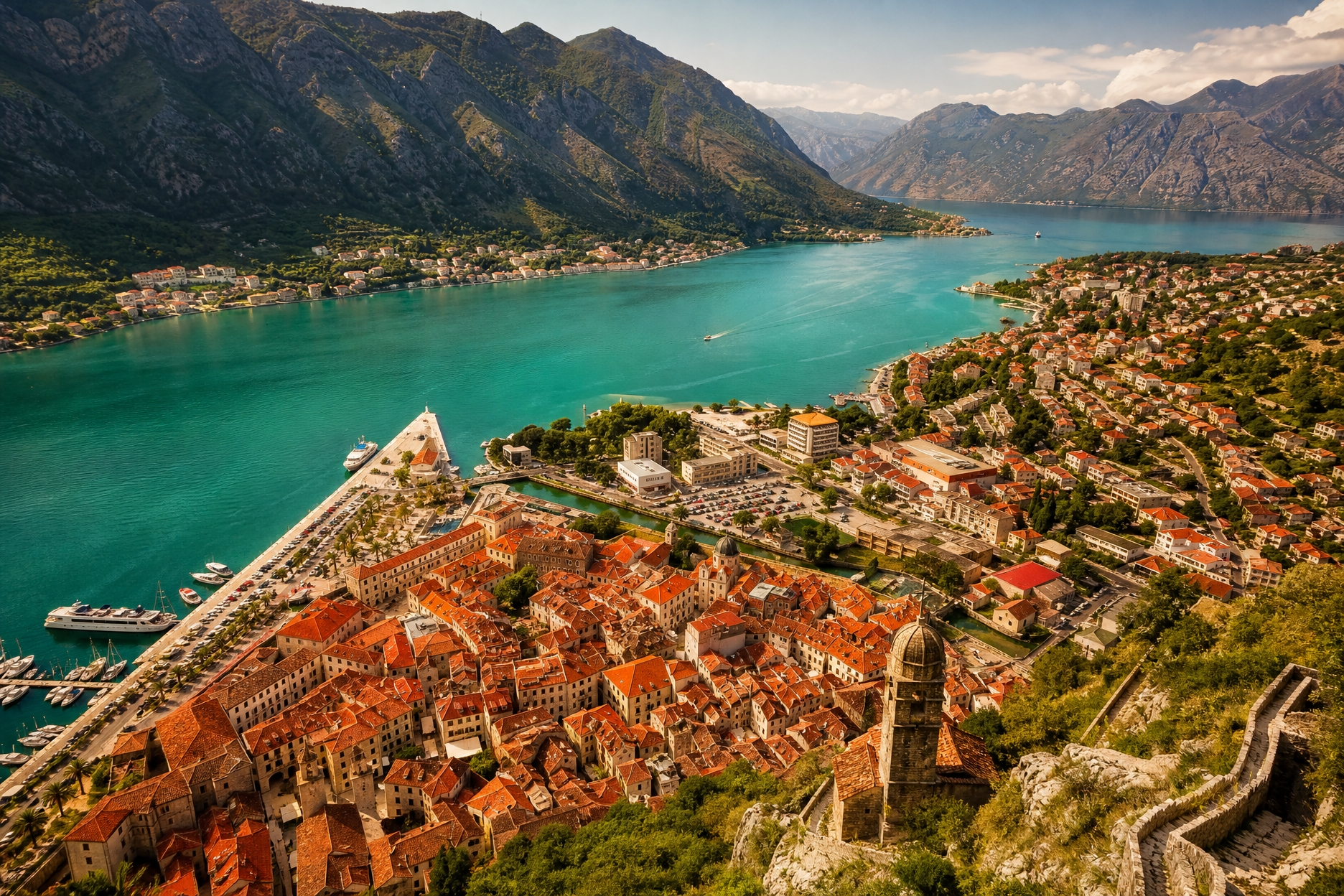
The Bay of Kotor is a fjord-like inlet that cuts 28 kilometres into the Montenegrin mountains — the deepest natural harbour in the Mediterranean and, to many visitors, the single most dramatic landscape in the Balkans. Medieval stone towns sit at the water's edge. A Venetian fortress climbs 280 metres above the bay. Two tiny islands — one natural, one man-made — hold churches visible from every shore. A cable car rises to 1,350 metres where the entire bay spreads out below you like a relief map. And when cruise ships leave in the evening, the old town empties and the restaurants fill with locals rather than tour groups.
This guide covers a complete Bay of Kotor day trip: the fortress hike at dawn, Kotor Old Town, the bus or boat to Perast, Our Lady of the Rocks, the cable car, and the hidden villages that most visitors drive past. An hour-by-hour itinerary, real costs, and the timing strategies that separate a spectacular day from an overcrowded one.
For the full destination guide, see our Montenegro travel guide. For daily costs, see Montenegro Travel Cost Per Day 2026. For car rental information, see Best Car Rental in Montenegro (Tested).
Quick Costs Overview
| Activity | Cost | Notes |
|---|---|---|
| Kotor fortress climb | €8 (ticketed gate) | Free via the Ladder of Kotor (separate, harder trail) |
| Kotor cable car (return) | €25 adults, €7 children (2–12) | 11 min each way; operates seasonally |
| Kotor Old Town | Free | No entrance fee to walk the old town |
| Blue Line bus (Kotor → Perast) | €2 | Cash to driver, 35 min, hourly |
| Taxi (Kotor → Perast) | €15–25 | Per vehicle |
| Boat (Perast → Our Lady of the Rocks) | €5 | Return trip, 5 min each way |
| Our Lady of the Rocks museum | €2–3 | Small museum inside the church |
| Risan Roman mosaics | €6 | 2nd-century floor mosaics |
| Bay of Kotor boat tour (3 hrs) | €30–50 | Blue Cave + Perast + islands |
| Lunch (sit-down, waterfront) | €12–22 | Per person, main + drink |
Total budget day trip: €30–50 per person (fortress, bus, Perast boat, lunch). Total mid-range day trip: €70–120 per person (fortress, boat tour, cable car, Perast, lunch and dinner).
The Hour-by-Hour Itinerary
This itinerary is designed for maximum experience with minimum crowd overlap. The timing revolves around one fact: cruise ships dock in Kotor between approximately 8:00 AM and 6:00 PM, and between 10:00 AM and 3:00 PM the Old Town is packed with 3,000 to 5,000 day-trippers moving through streets barely 3 metres wide. Beat the ships or outlast them.
07:00 — Fortress Gate Opens
Be at the San Giovanni Fortress entrance when the gate opens at 07:00 (May to September schedule; 08:00 in shoulder months). The entrance is inside the Old Town near Trg od Oružja, the main square — follow the signs.
The climb is 1,350 stone steps gaining 280 metres of elevation. Allow 45 to 60 minutes up, 15 to 30 minutes at the top, and 25 to 30 minutes down. The total out-and-back takes 90 minutes to 2 hours with photo stops.
At 07:00 AM, the path has partial shade on the lower sections from the old city walls, the upper sections are bearable because the stones have not yet absorbed the day's heat, and you share the fortress with a handful of early risers rather than hundreds of midday climbers. The light on the bay at this hour is golden — the best possible conditions for the iconic photograph of Kotor's red rooftops against the blue water.
What you will see: the Old Town shrinking below you, the Bay of Kotor opening in both directions, Perast and its two islands visible in the distance, the cruise ships in the harbour growing smaller with each switchback, and — from the ruined Venetian walls at the summit — a panorama that justifies every one of the 1,350 steps.
What to bring: at least 1 litre of water per person (no water sources on the path), shoes with grip (the polished stone steps are treacherous in sandals), sun hat, sunscreen. Leave heavy bags at your accommodation.
⚠️ Heads Up
Do not attempt the fortress climb between 10:00 AM and 3:00 PM in summer. The upper two-thirds of the path have zero shade. Stone steps absorb and radiate heat in temperatures exceeding 35°C. Dehydration, heat exhaustion, and falls on the descent are common enough that local medical services treat fortress-related incidents regularly in July and August. Start at gate opening or after 4:00 PM.
09:00 — Back Down, Old Town Exploration
You are back at the base by 09:00 to 09:30, before the cruise crowds have formed. The Old Town is at its quietest right now — locals are having coffee, shops are opening, and the alleys are yours.
Kotor's Old Town is a UNESCO World Heritage Site enclosed within medieval walls. The entire area is roughly 300 metres end to end — small enough to walk completely in 30 minutes but dense enough to reward an hour of wandering.
The highlights on foot: the Clock Tower in Trg od Oružja (the main square). The Cathedral of Saint Tryphon — Kotor's most important church, built in 1166, with a treasury and views from the upper gallery (€4 entry). The Maritime Museum in a restored baroque palace (€4). The Cat Museum — a small, quirky gallery dedicated to Kotor's famous street cats (€1). The narrow lanes behind the cathedral where laundry hangs between stone buildings and cats sleep on every windowsill.
Coffee stop: find a table in one of the small squares off the main strip — Trg od Drva or Trg Bokeljske Mornarice — before they fill with tour groups after 10:00.
10:00 — Escape the Cruise Rush: Head to Perast
By 10:00 the cruise ship crowds are pouring into Kotor's Old Town. This is your cue to leave. Head to Perast — the baroque jewel of the Bay of Kotor, 12 kilometres around the shore.
By bus: The Blue Line bus departs from the Riva stop directly in front of the Old Town walls. Hourly departures (Monday to Saturday every hour at :18 past, Sunday every 2 hours). Fare: €2 cash to the driver. Journey time: 35 minutes along the bay shore. Sit on the left side for unobstructed water views the entire way.
By taxi: €15 to €25 from outside the Old Town walls. Per vehicle. Journey: 15 to 20 minutes.
By rental car: 15 minutes along the bay road. Free or cheap parking in Perast, but spaces fill by 11:00 in summer — arrive early or park at the upper road and walk down.
By water taxi: Boats from Kotor's waterfront run to Perast. €10 to €15 per person. The scenic option — you see the bay from the water — but less frequent than the bus.
10:45 — Perast
Perast is the most beautiful village on the Bay of Kotor and one of the finest small baroque towns in the Mediterranean. During the Republic of Venice, Perast was a wealthy maritime town with 16 stone palaces, each grander than the last, lining a single waterfront promenade barely 400 metres long. The wealth came from seafaring — at its peak, Perast had more ships per capita than any port in the Venetian empire.
Today those palaces remain, their stone facades reflecting in the bay. Perast has no beach culture, no nightclubs, no souvenir shops selling fridge magnets. It has churches, palaces, two offshore islands, three restaurants, and an overwhelming sense of having stepped into a painting.
Walk the promenade from one end of the village to the other (10 minutes). Admire the palace facades — the Bujović Palace (now the Perast Museum, €5) and the Smekja Palace are the finest. Look for the lions of Venice carved above doorways — Perast remained loyal to Venice longer than any other bay town.
The two islands: directly offshore you see two small islands. On the right, Sveti Đorđe (Saint George) — a natural island with a Benedictine monastery, closed to visitors but photogenic from the shore. On the left, Gospa od Škrpjela (Our Lady of the Rocks) — a man-made island, open to visitors, and the essential Perast experience.
11:15 — Our Lady of the Rocks
Boat taxis to Our Lady of the Rocks depart from the Perast waterfront constantly in summer — you never wait more than 10 minutes. The ride is 5 minutes each way. Cost: approximately €5 per person return.
The island was man-made over centuries. According to local tradition, two brothers found an icon of the Madonna on a rock in the bay in 1452. Over the following generations, locals sank old ships and dropped stones around the rock after every safe return from sea, gradually building an island. The church on the island — built in 1630 — holds the icon, 68 paintings by the 17th-century Perast artist Tripo Kokolja (including a remarkably vivid ceiling), and a small museum displaying votive silver tablets left by sailors.
Cost: boat €5 return, museum €2 to €3. Total: approximately €7 to €8.
Time needed: 20 to 30 minutes on the island. The church, the museum, and the view back to Perast and the mountains are all contained in a small space.
💡 Pro Tip
Photograph Our Lady of the Rocks from the Perast waterfront with the mountains behind. The composition — island church, bay water, mountain wall — is the iconic Bay of Kotor image. Morning light (before noon) is best for this angle.
12:00 — Lunch in Perast
Perast has three to four waterfront restaurants and a handful of smaller spots. The quality is consistently high and the prices, despite the setting, are reasonable by coastal Montenegro standards.
Expect to pay: €12 to €22 per person for a main course and a drink. Seafood is the strength — grilled fish, black risotto, and octopus salad are the standard order. A full lunch for two with wine runs €35 to €55.
Where to sit: any table with a view of the two islands. In Perast, every waterfront table has this view — you cannot go wrong.
13:30 — The Bay Villages (If Driving)
If you have a rental car, the return from Perast to Kotor does not need to be direct. The bay road passes through villages that most visitors see only through a bus window.
Risan — The oldest settlement on the bay, founded by Illyrian Queen Teuta in the 3rd century BC. The Roman Villa Urbana contains remarkable 2nd-century floor mosaics, including a rare depiction of Hypnos, the Greek god of sleep — one of only a handful of Hypnos mosaics surviving in Europe. Entry: approximately €6. Time needed: 20 to 30 minutes.
Dobrota — The waterfront suburb of Kotor, stretching along the bay's eastern shore. A 2-kilometre promenade lined with former sea captains' houses, small churches, and swimming spots used by locals rather than tourists. Good for a quiet coffee stop with the bay on one side and the mountains on the other.
Ljuta — A tiny village at the end of the Dobrota promenade where a river of the same name cascades through a gorge into the bay. The water is startlingly cold — a natural spring emerging from the mountain. A beautiful and completely un-touristy stop.
Orahovac — Between Perast and Kotor on the bay's western shore. Small pebble beaches, a couple of family restaurants, and a pace of life that feels decades behind the busier bay towns.
14:30 — The Cable Car (Optional)
If you want a second perspective on the bay — this time from 1,350 metres rather than 280 — the Kotor cable car climbs from the Dub station (near the Old Town, reachable by shuttle bus or short taxi ride) to Kuk at the edge of Lovćen National Park.
Tickets: €25 return for adults, €7 for children (2 to 12). One-way: €14 adults, €4 children. Buy online to skip the queue.
Journey: 11 minutes each way in a modern gondola. The ascent is dramatic — the bay shrinks below you as the gondola climbs the mountain face.
At the top: a panoramic viewpoint, the Monte 1350 bar (drinks with the bay below you), Restaurant Forza Kuk, an alpine coaster (€12), and access to Lovćen National Park trails. Allow 45 minutes to an hour at the top.
Cable car versus fortress: These are not the same experience. The fortress climb is physical and intimate — you earn the view step by step, and the perspective is over the Old Town at 280 metres. The cable car is effortless and spectacular — you see the entire bay system from 1,350 metres, a fundamentally different panorama. If you have time, do both on the same day (fortress at 7 AM, cable car mid-afternoon). If you must choose one, the fortress is the more memorable experience for most people. The cable car is the better option for anyone who cannot manage 1,350 stone steps.
16:00 — Kotor Round Two (Post-Cruise)
By 4:00 PM, the cruise ships are recalling passengers and the Old Town transforms. Streets that were shoulder-to-shoulder at noon are now half-empty. Restaurants switch from serving rushed tour-group lunches to relaxed evening dining. The cats reappear on the walls and windowsills.
This is the time to revisit the Old Town's details you could not appreciate in the morning rush: the hidden squares, the tiny churches (Kotor has over 20 within its walls), the evening light on the stone facades, the sound of the bay lapping at the Sea Gate.
18:00 — Dinner
Inside the walls: Kotor's Old Town restaurants are atmospheric in the evening — stone walls, candlelight, the murmur of the bay beyond the gate. Prices are higher than outside the walls (€15 to €30 per main), but the setting justifies it for a final evening.
Outside the walls (better value): Walk to Dobrota or the area south of the bus station for restaurants serving the same Montenegrin cuisine at 25 to 40% less. Bay views are equally available from tables in Dobrota.
What to eat: Njeguški steak (pork stuffed with smoked ham and kajmak cheese, the Montenegrin national dish). Black risotto with cuttlefish ink. Grilled branzino or dorada from the bay. Finish with a glass of Vranac — Montenegro's signature red grape, surprisingly good for a small-production wine region.
Alternative: The Bay by Boat
If you prefer water over walking, a 3-hour boat tour from Kotor covers the bay's highlights without any transport logistics.
What a Boat Tour Includes
Most 3-hour tours follow a standard route: departure from Kotor waterfront, a panoramic circuit of the inner bay, the Blue Cave (a sea cave on the Luštica Peninsula where the water glows electric blue from underwater light), a swimming stop in the bay, a stop at Our Lady of the Rocks, and a pass by Perast before returning to Kotor.
Pricing
Group speedboat tours: €30 to €50 per person. Departures typically at 9:00, 12:00, 15:00, and 18:00.
Private speedboat (up to 8 to 9 passengers): €250 to €470 per boat. Flexible timing and route. Worthwhile for groups of 4 or more — the per-person cost drops to €60 to €115, with full privacy and flexibility.
Large group catamaran: €20 to €35 per person. Slower, less intimate, but cheaper.
When to Book
In July and August, popular operators sell out 2 to 3 days ahead. Book via Viator, GetYourGuide, or directly with operators on the Kotor waterfront. The 9:00 AM and 6:00 PM departures are typically least crowded.
The Serpentine Viewpoint
One of the most photographed spots in Montenegro is not in Kotor or Perast — it is on the road above, at a hairpin bend on the P1 highway climbing toward Lovćen.
The viewpoint sits at approximately 600 metres above sea level, looking down over the entire Bay of Kotor — Kotor Old Town, the cruise ships, Perast, the two islands, and the mountains closing in from both sides. The perspective is different from both the fortress (too close) and the cable car (too high) — this is the Goldilocks elevation where the bay's geography clicks into perfect composition.
How to reach it: by rental car (15 minutes from Kotor, climbing the Lovćen hairpins — the first 6 to 8 switchbacks of the famous 25-hairpin road). There are several informal pullover spots with low stone walls where you can park safely and photograph. By taxi: €15 to €20 return from Kotor with a 15-minute stop. By organised tour: most Lovćen day tours stop here.
When: late afternoon light (4:00 to 6:00 PM) is golden on the bay. Morning works too but the light is behind you.
If You Have Two Days
One day covers Kotor and Perast. A second day opens up the wider Bay of Kotor and the mountains above.
Day 2 option A: Lovćen loop. Drive the 25 hairpin bends from Kotor to Lovćen National Park. Stop at the serpentine viewpoint. Continue to Njeguši village for a pršut and cheese tasting (€5 to €7 — this constitutes a full meal). Climb the 461 steps to the Njegoš Mausoleum at the summit (€8 entry, panoramic views across four countries). Descend to Cetinje (Montenegro's old royal capital, museums at €2 to €5 each). Return to the coast via Budva.
Day 2 option B: Herceg Novi + Luštica. Bus or drive to Herceg Novi at the bay's entrance (40 to 60 minutes from Kotor). Explore the hillside Old Town with its Venetian fortress (Forte Mare), Ottoman-era clock tower, and Savina Monastery (free entry, 13th-century frescoes). Continue to the Luštica Peninsula for quiet beaches and the Blue Grotto boat trip from the village of Rose (€15 to €25).
Day 2 option C: Across the bay by ferry. The Lepetane–Kamenari car ferry crosses the bay's narrowest point in 10 minutes (€4.50 per car). This shortcut connects the inner bay to Tivat and Herceg Novi without driving the full bay loop — useful for car-based itineraries. The ferry runs every 10 to 15 minutes.
Getting to the Bay of Kotor
From Dubrovnik: Bus (€13 to €55, 2 to 3.5 hours), ferry (€50 to €60, seasonal), rental car (52 km, 1 hour plus border). See our Kotor to Dubrovnik guide.
From Podgorica: Bus (€9 to €12, 2 to 2.5 hours, 10+ daily). Rental car (90 km, 1.5 hours via the Sozina Tunnel at €3.50 toll, or 2 hours via the scenic mountain road).
From Tivat Airport: Taxi or transfer (€15 to €25, 15 minutes). The closest airport to Kotor.
From Budva: Bus (€3.50 to €5, 35 to 50 minutes, every 20 to 40 minutes in summer). One of the easiest day trips in Montenegro.
Practical Details
Parking in Kotor: No vehicles inside the Old Town. Paid lots outside the walls: €0.50 to €1.50/hour, €5 to €8/full day. Arrive before 8:00 AM in summer or park in Dobrota (free spots 500+ metres from the Old Town) and walk.
Cruise ship calendar: Check the Kotor port schedule online before your visit. On days with 2 to 3 large ships in port, the Old Town between 10:00 and 15:00 is genuinely unpleasant. Zero-ship days exist — particularly mid-week in shoulder season — and the difference is dramatic.
Connectivity: Wi-Fi is available in most Kotor and Perast cafés. Mobile data works throughout the bay. An eSIM ensures you have navigation and real-time transport information from arrival. See our eSIM comparison.
Cash: Carry euros in small denominations. Bus drivers (€2, cash only), boat operators (€5, cash preferred), market vendors, and smaller restaurants often do not accept cards. ATMs are available in Kotor Old Town and at the bus station.
Weather: Summer temperatures in Kotor reach 35°C+. The bay's enclosed geography traps heat. The fortress climb in particular demands early starts. Spring and autumn are ideal — warm enough for outdoor dining, cool enough for comfortable hiking, and cruise ship visits are less frequent.
Frequently Asked Questions
Can you do the Bay of Kotor in one day? Yes. The itinerary above covers the fortress, Kotor Old Town, Perast, Our Lady of the Rocks, and a waterfront lunch in a single full day. Adding the cable car or serpentine viewpoint requires efficient timing but is doable. Two days is better — it allows the Lovćen loop or Herceg Novi on day two.
Is the Kotor fortress climb worth it? It is the single best thing to do in Kotor and one of the finest viewpoints in the Balkans. Start at gate opening (07:00 in summer) and it is absolutely worth the 1,350 steps. Start at noon in August and it is dangerous and miserable. Timing is everything.
How much does the Kotor cable car cost? €25 return for adults, €7 for children (2 to 12). One-way: €14 adults, €4 children. Buy online to skip the queue. The cable car operates seasonally and closes in bad weather — check before planning around it.
How do I get from Kotor to Perast? Blue Line bus: €2 cash, 35 minutes, hourly (every 2 hours on Sundays). Taxi: €15 to €25 per vehicle. Water taxi: €10 to €15 per person. Rental car: 15 minutes.
How much is the boat to Our Lady of the Rocks? Approximately €5 per person return from the Perast waterfront. Boats leave constantly in summer — you rarely wait more than 10 minutes. The ride is 5 minutes each way.
When is the best time to visit the Bay of Kotor? September for the best balance of warm weather, warm sea, thin crowds, and lower prices. June is excellent for the fortress and Old Town (fewer cruise ships than peak summer). Avoid midday in July and August when cruise crowds peak and temperatures soar.
Is the Bay of Kotor a day trip from Dubrovnik? Yes — one of the most popular day trips in the region. By bus, car, or private transfer, the journey is 1 to 3.5 hours depending on transport and border conditions. Leave early (before 8:00 AM) to beat the Karasovići border queue. See Kotor to Dubrovnik: All Transport Options.
Should I take a boat tour or visit independently? Both work. Independent visiting (bus to Perast, boat to the island, walk Kotor) costs €15 to €25 and gives you complete flexibility. A 3-hour boat tour (€30 to €50) adds the Blue Cave, a swimming stop, and a panoramic bay circuit with zero transport logistics. If you have a full day, visit independently. If you have half a day, the boat tour covers the highlights efficiently.
The Bay of Kotor rewards the early riser. The fortress at 7 AM with golden light on the water. Perast at 10:30 before the tour boats arrive. Our Lady of the Rocks with a handful of visitors rather than a crowd. The serpentine viewpoint in late afternoon when the bay turns copper. The Old Town at 6 PM when the cruise ships have gone and the cats reclaim the walls. Every one of these moments is free or nearly free. The bay itself is the attraction — the towns, the islands, the mountains, and the water between them — and it costs almost nothing to experience at its best. You just have to be there at the right time.
For the full Montenegro guide, see Montenegro travel guide. For onward travel, read Kotor to Dubrovnik: All Transport Options.