📋 Quick Facts
| Detail | Info |
|---|---|
| Currency | Albanian lek (ALL). €1 ≈ 100 ALL. Euros accepted at beaches but at poor rates. |
| Language | Albanian (Shqip). English widely spoken by younger locals. |
| Visa | US citizens: up to 1 year visa-free. EU/UK/Canada/Australia: 90 days visa-free. |
| Power Plug | Type C and F (two round pins). Bring an adapter if coming from the US or UK. |
| Tap Water | Not safe to drink. Buy bottled water or bring a filter bottle. |
| Emergency | 112 |
| SIM / eSIM | Vodafone or One Albania tourist SIM from €5. eSIM via Airalo from €4.50. |
| Best Months | June and September — warm water, thinner crowds, lower prices. |
Overview
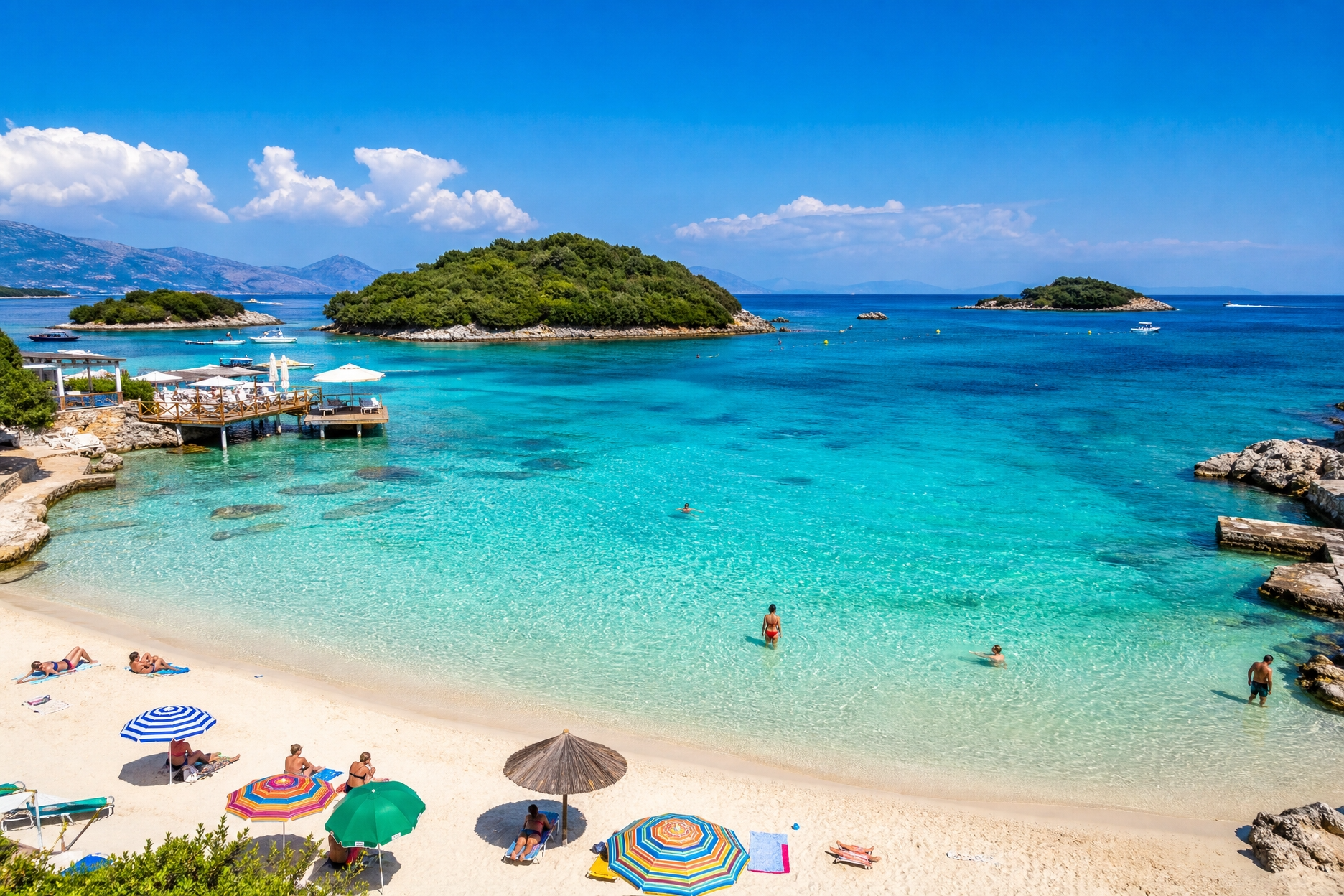
Albania is the destination that keeps catching the rest of Europe off guard. Wedged between Montenegro, Kosovo, North Macedonia, and Greece on the western Balkans, it packs an extraordinary range of landscapes into a country smaller than Belgium: a 120-kilometer Ionian coastline with water clarity rivalling the Greek islands, two UNESCO World Heritage cities stacked with Ottoman architecture, the jagged peaks of the Accursed Mountains, and a capital that reinvented itself with street art and cafe culture.
Until 1991, Albania was the most isolated country in Europe. The dictator Enver Hoxha sealed borders, banned religion, and built roughly 173,000 concrete bunkers — one for every four citizens — to defend against an invasion that never came. That isolation preserved landscapes, traditions, and a pace of life that feel increasingly rare on the continent.
Today Albania is open, welcoming, and remarkably affordable. A full meal at a local restaurant costs €4 to €8. A private double room on the coast runs €35 to €70 a night. A bus from Tirana to the Riviera is €8 to €15. For travellers looking for a genuine Mediterranean experience without Mediterranean prices, Albania is the strongest value proposition in southern Europe right now.
Tourism is growing fast — 4.5 million visitors arrived in the first half of 2024 alone, a 34 percent jump year over year. Infrastructure is catching up: roads are improving, shuttle services now operate with online booking, and new boutique hotels open every season. The window where Albania feels raw and uncrowded is narrowing, which makes 2026 an ideal year to go.
💡 Pro Tip
Albania uses the cultural code of besa — a deep tradition of honour and hospitality towards guests. Accept the offered coffee or raki, and you will experience a warmth that no hotel concierge can replicate.
Best Time to Visit
Albania is a year-round destination, but the experience changes dramatically by season.
June and September are the sweet spot. The Ionian Sea reaches 23–25°C, daytime air temperatures sit at 26–30°C, and the crowds that pack the Riviera in July and August have thinned. Accommodation prices drop 30 to 50 percent from peak, and you can still swim comfortably every day. September is especially good: the sea retains its summer warmth while the light turns golden.
July and August are peak season. The sea is warmest (25–26°C), beach bars are open everywhere, and the coast buzzes with energy. The trade-off is higher prices, packed beaches at Ksamil and Dhermi, and accommodation that books out weeks in advance. If you visit in peak season, book early and consider basing yourself in Himara or Qeparo rather than the headliner towns.
April, May, and October are shoulder months. Great for hiking the Valbona-to-Theth trail, exploring Berat and Gjirokaster without crowds, and enjoying Tirana's cafe scene. The sea is too cool for casual swimming in April (16°C) but pleasant by late May (19°C) and still comfortable in October (22°C).
November through March is the off-season. Most Riviera hotels and beach clubs close. Tirana and the southern cities remain open and prices are lowest. Temperatures range from 6 to 16°C. The mountains see snow — if you are interested in skiing, Dardhe and Boga have small resorts.
| Month | Water °C | Air °C | Crowds | Prices |
|---|---|---|---|---|
| Apr | 16 | 18–22 | Very low | Budget |
| May | 19 | 22–26 | Low | Budget |
| Jun | 23 | 26–30 | Moderate | Mid |
| Jul | 25 | 30–34 | High | Peak |
| Aug | 26 | 30–35 | Very high | Peak |
| Sep | 25 | 26–30 | Moderate | Mid |
| Oct | 22 | 20–25 | Low | Budget |
How to Get There
Flying In
Albania has one operating international airport: Tirana International Airport (TIA), also called Nënë Tereza. Direct flights connect to most major European hubs including London, Rome, Milan, Istanbul, Vienna, Munich, and Athens. Budget carriers Wizz Air and Ryanair serve many of these routes with fares as low as €25 to €50 one way if booked early.
There is no direct flight from the United States or Canada. The most efficient routing is through Istanbul (Turkish Airlines), Rome (ITA Airways or Wizz Air), or Vienna (Austrian Airlines).
Vlora International Airport (VLO) is built — runway, terminal, and all — but has never operated a single commercial flight. The delay is a legal dispute, not an engineering problem. Do not book travel plans assuming VLO is open; as of September 2026, it remains closed with no confirmed opening date.
An alternative is to fly into Corfu (CFU) in Greece and take the ferry to Saranda. The crossing takes 30 to 40 minutes and costs €10 to €15. This is an excellent option if the Albanian Riviera is your main destination and Corfu has a cheaper flight.
Getting from Tirana to the Coast
The Albanian Riviera is roughly 4 to 6 hours south of Tirana by road. You have several options:
| Transport | Route | Cost | Duration | Notes |
|---|---|---|---|---|
| Public bus | Tirana → Himara | €8–12 | 4–5 hrs | Departs early morning from South Station |
| Public bus | Tirana → Saranda | €10–15 | 5–7 hrs | Multiple stops along the coast |
| Shuttle (RivieraBus) | Tirana → Saranda | €50 | 4–5 hrs | Online booking, max 7 passengers, Wi-Fi, water |
| Rental car | Tirana → Himara | €25–45/day | 3.5–4 hrs | Most flexibility. SH8 is scenic but winding. |
| Private transfer | Tirana → Saranda | €100–140 | 3.5 hrs | Book via your hotel or RivieraBus |
💡 Pro Tip
If you rent a car, the drive over the Llogara Pass (1,027 metres) is one of the most dramatic coastal roads in Europe. The new Llogara Tunnel charges a toll of 250 lek (~€2.50) and shaves 20 minutes off the drive, but the old pass road with its panoramic views is worth doing at least once.
Where to Stay
Albania offers accommodation for every budget, from €15 hostel dorms to €200+ luxury resorts. Here is a breakdown by area.
Tirana
The capital is your likely arrival point. The Blloku neighbourhood is the centre of nightlife and cafes — ideal for a first or last night. Budget guesthouses in Blloku run €30 to €50 per night. The Tirana International Hotel and Melia Durres (45 minutes north) anchor the upper-mid range at €80 to €120.
Saranda and Ksamil
The main tourist hub of the south coast. Saranda has the widest range of hotels, from budget to mid-range. Ksamil, 20 minutes south, is famous for its sandy beaches and small islands but gets very crowded in August. Expect €40 to €80 for a private room in summer, €15 to €25 in a hostel.
Himara
A quieter, more authentic alternative to Saranda. The old town sits on a hilltop above the beach. Boutique guesthouses here offer excellent value at €35 to €70. The town beach is one of the few sandy stretches on the Riviera.
Dhermi and Palasa
These twin villages sit just south of the Llogara Pass. Dhermi's promenade has a reputation for beach bars and nightlife, while Palasa (home to the Green Coast development) is quieter and more upscale. Expect €60 to €150 per night for a good hotel or apartment.
Berat and Gjirokaster
Albania's two UNESCO cities are inland and less expensive. Budget guesthouses in traditional Ottoman houses run €25 to €45 per night and often include breakfast. Both cities are best visited as one- or two-night stops.
ℹ️ Good to Know
Booking tip: Accommodation along the Riviera books out fast for July and August. Reserve at least 4 to 6 weeks ahead for peak season. For September, 2 to 3 weeks is usually enough.
Things to Do
The Albanian Riviera
The 120-kilometre coastline from Llogara to Ksamil is Albania's headliner. Key beaches, ranked roughly north to south:
Palasa Beach — Fine white pebbles, 20-metre water clarity, dramatic cliff backdrop. Less developed than Dhermi. Best for couples and photographers.
Dhermi Beach — The Riviera's party beach. Long pebble shore with beach bars, DJs, and a young crowd in summer. Water is crystal clear.
Gjipe Beach — Reached by a 20-minute canyon hike or boat. A wild cove wedged between 70-metre limestone walls. Arrive by 9am for solitude.
Himara Town Beach — One of the only sandy beaches on the Riviera. Backed by the old hilltop town. Family-friendly with gentle entry.
Borsh Beach — At 7 kilometres, the longest beach in Albania. Fine pebbles, mostly empty, backed by olive groves. Perfect for long walks.
Porto Palermo — A 15th-century castle sits on a tiny peninsula above a protected bay. Stunning for snorkelling and photos.
Ksamil — Sandy beaches, small swim-to islands, and the warmest water on the coast. Beautiful but crowded in peak season. Visit in June or September.
UNESCO Cities
Berat — The City of a Thousand Windows. White Ottoman houses cascade down a hillside above the Osum River. Walk up to Berat Castle for panoramic views and visit the Onufri Museum inside.
Gjirokaster — A dramatic stone city built into a mountainside, birthplace of both Enver Hoxha and author Ismail Kadare. The bazaar and castle are not to be missed.
The Blue Eye (Syri i Kalter)
A mesmerising karst spring 25 kilometres from Gjirokaster where water of unknown depth rises to the surface in an intense blue circle. Entry is 100 lek (~€1). Combine with a Gjirokaster day trip.
The Albanian Alps
Theth and Valbona are connected by one of the best day hikes in the Balkans — a 6- to 7-hour mountain crossing at 1,800 metres. The Lake Komani ferry (2.5 hours through a narrow gorge flanked by cliffs) is often described as one of the most scenic boat rides in Europe.
Tirana
Walk Skanderbeg Square, visit Bunk'Art (a massive nuclear bunker turned museum documenting Albania's communist era), ride the Dajti Ekspres cable car for city-wide views, and wander the chaotic energy of the Blloku neighbourhood.
Costs and Budget
Albania remains one of the cheapest countries in southern Europe. The currency is the Albanian lek (ALL), and €1 is approximately 100 lek. ATMs are widely available; cards are accepted at hotels and nicer restaurants in cities and along the coast, but cash is essential in smaller towns, for furgons (local minibuses), and at rural guesthouses.
Daily Budget Ranges
| Travel Style | Daily Cost (per person) | Includes |
|---|---|---|
| Budget | €35–60 | Hostel or shared guesthouse, byrek and street food, public buses, free beaches |
| Mid-range | €70–130 | Private hotel room, restaurant meals, shuttle or rental car, beach clubs |
| Comfort | €150–250+ | Boutique hotel or villa, fine dining, private transfers, guided excursions |
Typical Prices (2026)
| Item | Cost |
|---|---|
| Byrek (cheese pastry) | €0.50–1.00 |
| Local restaurant meal | €4–8 |
| Mid-range restaurant dinner | €10–20 |
| Espresso | €0.50–0.80 |
| Pint of local beer (bar) | €1.50–2.50 |
| Cocktail at a beach bar | €3–8 |
| Hostel dorm bed | €15–25/night |
| Budget guesthouse (double) | €30–50/night |
| Mid-range hotel (double) | €60–120/night |
| Boutique / resort | €120–250+/night |
| Rental car | €20–45/day |
| Petrol (1 litre) | €1.50–1.70 |
| Tirana → Himara bus | €8–12 |
| Tirana → Saranda bus | €10–15 |
| SIM card (tourist, 10GB) | €5–8 |
💡 Pro Tip
Save money: Eat at small local restaurants where the menu is only in Albanian — the food is better and cheaper. Skip Ksamil in peak season and base yourself in Himara or Qeparo instead. Travel in June or September for lower accommodation prices and fewer crowds.
Essential Tips
Money
Albania is still largely a cash economy outside of Tirana and the main Riviera hotels. ATMs dispense lek only. Avoid exchanging euros at beach kiosks — the rates are poor. A travel-friendly debit card with no foreign transaction fees (like Wise or Revolut) is the best way to manage money.
Language
Albanian (Shqip) is a unique Indo-European language unrelated to any of its neighbours. Younger Albanians in cities and tourist areas generally speak good English. Italian is also widely understood along the coast. Learn a few phrases — Faleminderit (thank you) and Mirëdita (good day) go a long way.
Watch out for the Albanian nod: a slight head tilt means yes (po), while an upward nod means no (jo). It catches nearly everyone off guard.
Safety
Albania is safe for travellers. Violent crime against tourists is extremely rare, and the country is broadly considered safer than many western European capitals. The biggest genuine risk is traffic — driving in Albania is aggressive, roads are narrow and winding, and pedestrian crossings are treated as suggestions. Exercise extra caution when driving or crossing streets, especially at night. Do not drive in rural mountain areas after dark.
Petty theft (pickpocketing) exists in crowded areas, as it does everywhere in Europe. Keep valuables close in markets and on public transport.
Connectivity
A local SIM card costs €5 to €8 with 10GB of data. Vodafone has the best geographic coverage; One Albania has faster speeds in cities. Alternatively, buy an eSIM from Airalo or similar before you arrive — your data will work the moment you land. Free Wi-Fi is available in most cafes, hotels, and some public squares. For more details, see our Best eSIM for the Balkans guide.
Food to Try
Albanian cuisine blends Mediterranean, Ottoman, and Balkan traditions. Do not leave without trying tavë kosi (baked lamb with yoghurt — the national dish), byrek (filo pastry with cheese, spinach, or meat), fërgesë (baked peppers, tomatoes, and cheese), qofte (grilled herb meatballs), and trilece (a three-milk sponge cake that rivals any dessert in the region). Wash it all down with locally made raki — but sip, do not shoot. Homemade raki can reach 50 percent ABV.
Getting Around Within Albania
A rental car is the single best way to see Albania. It unlocks mountain villages, hidden beaches, and canyon roads that public transport cannot reach. Rates start at €20 to €25 per day for a compact car. Roads have improved but remain narrow and winding on the coast; a 4WD is recommended for the road to Theth.
Without a car, you have three options: pre-booked buses on platforms like 12Go or Busbud (more reliable, fixed schedule), furgons (unlicensed local minibuses that leave when full — cheap and adventurous), and shuttle services like RivieraBus (€50 Tirana to Saranda, max 7 passengers, Wi-Fi on board, bookable online). There is no Uber in Albania; the ride-hailing app Bolt works in Tirana only.
Packing Essentials
Bring water shoes — most Albanian Riviera beaches are pebble, not sand. A reusable filter water bottle saves money since tap water is not drinkable. A portable battery pack is useful for long bus rides and hikes with no outlets. And a universal power adapter (Type C/F) if you are coming from the US, UK, or Australia.
ℹ️ Good to Know
Visa note for US citizens: Albania allows stays of up to one year without a visa. Your passport must be valid for at least three months beyond your arrival date. EU citizens can enter with just a national ID card. UK, Canadian, and Australian citizens get 90 days visa-free.
Albania rewards the curious. The roads are not always smooth, the buses do not always arrive on time, and the tap water will betray you if you let it. But the mountains are wild, the coastline is stunning, the food is honest, and the people will welcome you like family. Visit before the rest of the world fully catches on.
For a deep dive into the Riviera specifically, read our Albanian Riviera: The Complete 2026 Guide. For transport logistics, see How to Get from Tirana to the Albanian Riviera.
More Albania Guides
Guide
How Much Does Albania Really Cost?
Real 2026 prices for Albania: accommodation, food, transport, beaches and activities, plus sample budgets for one week on the Riviera and inland.
Guide
Albanian Riviera on a Budget: Daily Costs 2026
A line-by-line breakdown of what the Albanian Riviera actually costs in 2026 — accommodation, food, beaches, transport, and activities at every budget level. Real prices from Himara to Ksamil, with tested strategies to keep your daily spend under €50.
Guide
Albanian Riviera: The Complete 2026 Guide
Everything you need to plan your Albanian Riviera trip in 2026. Beaches, towns, costs, transport, safety, and where to stay — honest, updated, and based on real travel data.
Guide
Best Beaches on the Albanian Riviera (Ranked)
Every beach on the Albanian Riviera ranked for 2026 — from the wild canyon of Gjipe to the turquoise islands of Ksamil. Honest reviews with sunbed prices, access details, crowd levels, and which beaches are actually worth the hype.