Destination Guide
North Macedonia Travel Guide
📋 Quick Facts
| Detail | Info |
|---|---|
| Currency | Macedonian denar (MKD). €1 ≈ 61.50 MKD. Euros sometimes accepted at hotels but at poor rates. |
| Language | Macedonian. English spoken in tourist areas; Albanian widely spoken in the west. |
| Visa | US/UK/Canada/Australia: 90 days visa-free. EU citizens: visa-free with passport or ID card. |
| Power Plug | Type C and F (two round pins, 230V/50Hz). Bring an adapter if coming from the US or UK. |
| Tap Water | Generally safe in cities (Skopje, Ohrid). Stick to bottled water in rural areas. |
| Emergency | 112 (general), 192 (police), 194 (ambulance), 196 (roadside assistance) |
| SIM / eSIM | A1 or T-Mobile prepaid SIM from €5. eSIM via Airalo from €4.50. |
| Best Months | May–June and September — warm, dry, uncrowded, and affordable. |
Overview
North Macedonia is one of those countries that travellers rarely plan for but never forget. Landlocked in the heart of the Balkans, bordered by Kosovo, Serbia, Bulgaria, Greece, and Albania, it packs an outsized amount of history, landscape, and character into just 25,713 square kilometres — roughly the size of Vermont. The population is about 1.8 million, which means that even at the height of summer, most of the country feels genuinely uncrowded.
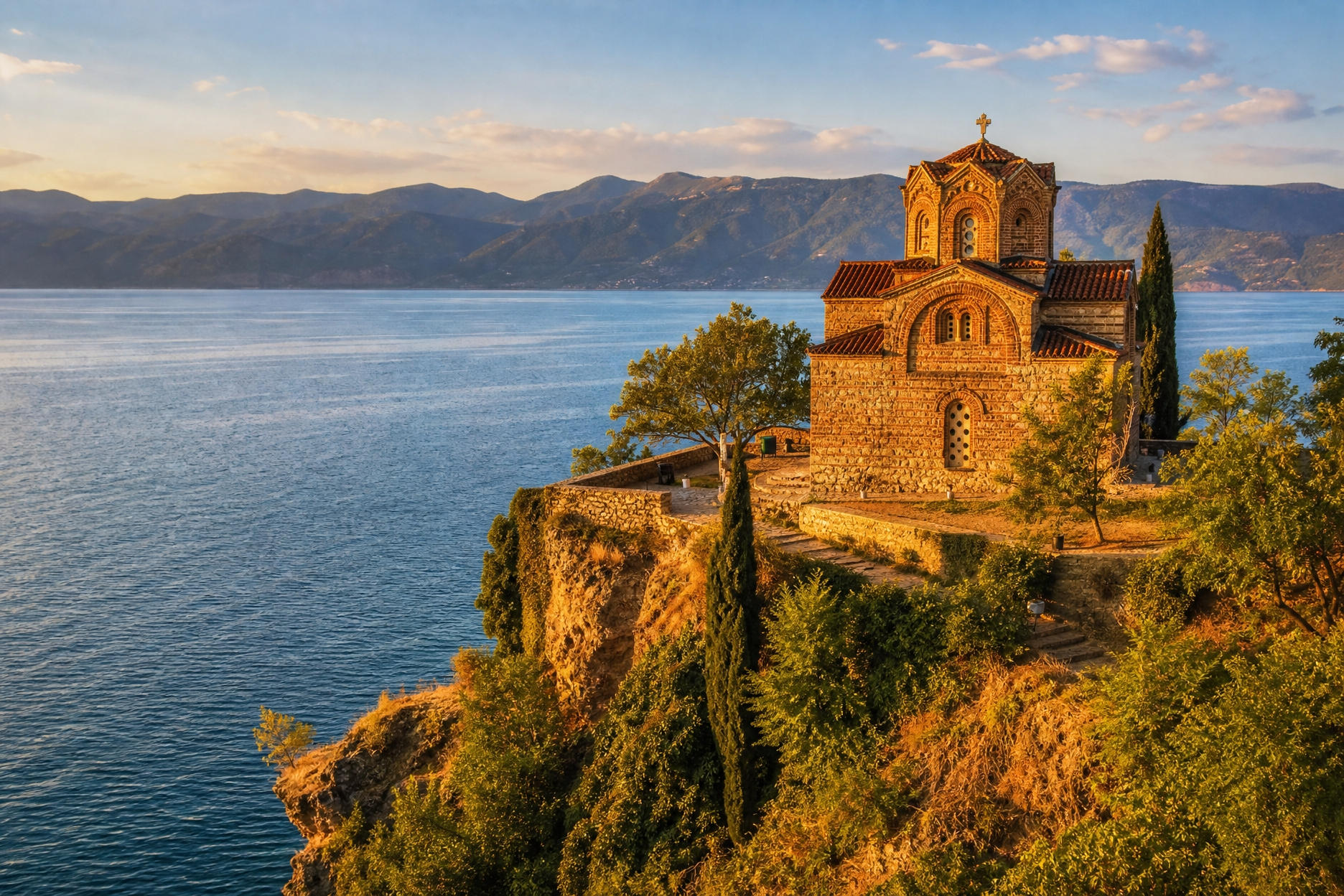
The headline attraction is Lake Ohrid — one of the oldest and deepest lakes in Europe, a UNESCO World Heritage Site since 1979, and surrounded by Byzantine churches, medieval fortresses, and a town that has been continuously inhabited for over 2,500 years. But North Macedonia has far more than one lake. Matka Canyon, just 30 minutes from the capital, cuts through limestone cliffs above turquoise water. Mavrovo and Pelister National Parks offer alpine hiking, wolves, bears, and the critically endangered Balkan lynx. The Tikveš wine region produces underrated reds that rival anything from neighbouring Greece at a fraction of the price.
Skopje, the capital, is unlike any other European city. A massive government rebuilding project in the 2010s filled the centre with oversized statues, neoclassical facades, and monumental bridges — earning it the nickname "the Las Vegas of the Balkans." Behind the kitsch, though, the Old Bazaar (Čaršija) is one of the largest and best-preserved Ottoman marketplaces in the region, full of copper workshops, tea houses, and mosques dating to the 15th century.
And then there is the cost. North Macedonia is one of the cheapest countries in Europe, full stop. A full restaurant meal costs €4 to €8. A comfortable double room costs €30 to €60 per night. A bus from Skopje to Ohrid is €10 to €15. A cappuccino is €1.50. For travellers on a budget — or anyone who simply likes getting extraordinary value — this country delivers in a way that few others in Europe still can.
Tourism is growing but remains modest by Balkan standards. Infrastructure has improved significantly in recent years, with upgraded highways and increased flight connections making it easier than ever to visit. The window where North Macedonia feels like a genuine discovery is still wide open. 2026 is an excellent year to go.
💡 Pro Tip
North Macedonia is one of only a few countries named after a historical region — in this case, the ancient kingdom of Macedon. The "North" was added in 2019 following the Prespa Agreement with Greece. Locals are proud and opinionated about the distinction — approach the topic with curiosity, not assumptions.
Best Time to Visit
North Macedonia has a continental climate inland and a milder, Mediterranean-influenced climate around Lake Ohrid. Summers are hot, winters are cold, and the shoulder seasons are the sweet spot.
May and June are ideal. Temperatures range from 20 to 28°C, wildflowers cover the national parks, Lake Ohrid is warm enough for swimming by late June (19–21°C), and tourist numbers are manageable even in Ohrid's Old Town. Prices are 20 to 30 percent below peak season.
July and August are peak season. Temperatures regularly exceed 35°C in Skopje and the lowlands. Lake Ohrid is at its warmest (23–24°C) and liveliest — beach bars, boat trips, and the Ohrid Summer Festival are in full swing. Accommodation in Ohrid books up fast and prices rise. Skopje can feel oppressively hot. If you visit in peak summer, plan for early mornings, long lunches, and evening explorations.
September and early October offer a second sweet spot. Temperatures drop to a pleasant 20–26°C, the lake is still swimmable (20–22°C in September), autumn colours begin in the mountains, and it is wine harvest season in Tikveš. Crowds thin noticeably after the first week of September.
November through March is the off-season. Most lakeside restaurants and smaller hotels close. Skopje remains open and atmospheric, and Mavrovo transforms into North Macedonia's main ski destination with lift passes around €15 to €20 per day — far cheaper than Alpine resorts. Expect temperatures from -2 to 10°C, with snowfall in the mountains.
| Month | Lake °C | Air °C | Crowds | Prices |
|---|---|---|---|---|
| Apr | 11 | 14–20 | Very low | Budget |
| May | 15 | 18–25 | Low | Budget |
| Jun | 19 | 22–28 | Moderate | Mid |
| Jul | 23 | 26–33 | High | Peak |
| Aug | 24 | 26–35 | Very high | Peak |
| Sep | 20 | 20–27 | Moderate | Mid |
| Oct | 15 | 14–20 | Low | Budget |
How to Get There
Flying In
North Macedonia has two international airports. Skopje International Airport (SKP) is the main hub, located 25 kilometres southeast of the capital. Direct flights connect to London, Vienna, Istanbul, Zürich, Basel, Milan, and several other European cities. Wizz Air is the dominant budget carrier, with fares as low as €20 to €50 one way if booked early. Turkish Airlines and Austrian Airlines offer full-service connections.
Ohrid St. Paul the Apostle Airport (OHD) handles seasonal flights, mainly from April to October, with connections to a handful of European cities. If Lake Ohrid is your main destination and a flight is available, this saves a 3-hour bus ride from Skopje.
There is no direct flight from the United States or Canada. The most efficient routings are through Istanbul (Turkish Airlines), Vienna (Austrian Airlines), or Zürich (Swiss).
A practical alternative is to fly into Thessaloniki (SKG) in Greece (4 to 5 hours by bus to Skopje or Ohrid) or Pristina (PRN) in Kosovo (1.5 to 2 hours by bus to Skopje).
Getting from Skopje Airport to the City
| Transport | Route | Cost | Duration | Notes |
|---|---|---|---|---|
| Airport shuttle bus | Airport → Skopje bus/rail station | 199 MKD (~€3.25) | 30–40 min | Regular departures, buy on board |
| Taxi | Airport → Skopje centre | €20–25 | 20–25 min | Fixed rate, pay cash |
| Private transfer | Airport → Skopje centre | €25–30 | 20–25 min | Pre-book online |
Intercity Transport
Buses are the backbone of travel within North Macedonia. Key routes:
| Route | Transport | Cost | Duration | Notes |
|---|---|---|---|---|
| Skopje → Ohrid | Bus | €10–15 | 3–3.5 hrs | Multiple daily departures |
| Skopje → Bitola | Bus | €8–10 | 3 hrs | Frequent service |
| Ohrid → Bitola | Bus | €5–7 | 1.5 hrs | Easy day trip |
| Skopje → Matka Canyon | Taxi/bus | €5–8 | 30 min | No direct bus — taxi or local bus + short walk |
| Thessaloniki (GR) → Skopje | Bus | €25–35 | 4–5 hrs | International route, book ahead |
| Pristina (KS) → Skopje | Bus | €3–5 | 1.5–2 hrs | Very frequent, extremely cheap |
| Belgrade (RS) → Skopje | Bus | €25–35 | 6–8 hrs | Overnight options available |
| Sofia (BG) → Skopje | Bus | €20–30 | 5 hrs | Several daily departures |
💡 Pro Tip
Trains exist in North Macedonia but are slow and infrequent. The Skopje–Bitola line is scenic but takes over 4 hours for a journey that buses do in 3. Trains cost only €3 to €5, so if you have time and want a nostalgic experience, go for it — but for efficiency, take the bus.
Where to Stay
North Macedonia offers some of the lowest accommodation prices in Europe. Here is a breakdown by destination.
Skopje
The capital has the widest range of options. Stay near Macedonia Square for central access, or in the Old Bazaar area for atmosphere. Hostel dorms run €8 to €15 per night. Budget apartments and guesthouses cost €25 to €40 for a double. Mid-range hotels like the Marriott or Stone Bridge Hotel cost €55 to €90. For luxury, the Alexander Palace Hotel runs €100 to €140 — roughly what a budget hotel costs in Western Europe.
Ohrid
Lake Ohrid is the top tourist destination, and prices here are the highest in the country — though still very affordable by European standards. In peak season (July–August), expect €40 to €70 for a well-reviewed apartment or guesthouse with lake views, and €10 to €15 for a hostel dorm. The Old Town is the most atmospheric base but also the priciest. The residential neighbourhoods along the western lakeshore (Kaneo, Lagadin) offer better value and are within easy walking or swimming distance.
Bitola
North Macedonia's second city is undervisited and affordable. Charming guesthouses and apartments near Širok Sokak (the main pedestrian boulevard) run €20 to €40 per night. Boutique hotels with breakfast cost €35 to €55.
Mavrovo
The national park area has guesthouses, mountain lodges, and a few small hotels. Expect €25 to €50 per night. Ski season (December–March) is the busiest period but prices remain modest.
ℹ️ Good to Know
Booking tip: Ohrid books up fast for July and August, especially lakefront apartments. Reserve at least 3 to 4 weeks ahead for peak season. Skopje and Bitola rarely have availability issues outside major events.
Things to Do
Lake Ohrid
The centrepiece of any North Macedonia trip. Lake Ohrid is one of Europe's oldest lakes — estimated at 1 to 4 million years old — and holds over 200 endemic species. The town of Ohrid itself is a living museum.
Church of St. John at Kaneo — The single most photographed spot in North Macedonia. A 13th-century church perched on a cliff directly above the lake, with Byzantine frescoes inside. The walk along the lakeside path from the Old Town to Kaneo is magical at sunset. Free to view from outside; small entry fee (100–150 MKD / ~€2) for the interior.
Samuel's Fortress — The ramparts of the 10th-century fortress that crowned the First Bulgarian Empire offer 360-degree views over the lake, the town, and the mountains of Galičica. Entry is 150 MKD (~€2.50).
Ancient Theatre of Ohrid — A remarkably preserved Hellenistic amphitheatre, still used for summer performances during the Ohrid Summer Festival (July–August).
Monastery of St. Naum — Located 29 kilometres south of Ohrid, near the Albanian border. The setting is extraordinary: peacocks wander the grounds, natural springs feed the lake, and the monastery itself dates to 905 AD. Reach it by car, bus, or — more memorably — by boat along the lake.
Boat trips — Regular boats run from Ohrid harbour to St. Naum and along the eastern shore. A round trip costs €8 to €15. On a calm day, the water clarity is stunning.
Skopje
Walk the Old Bazaar — one of the oldest and largest marketplaces in the Balkans, full of coppersmiths, mosques, tea houses, and hidden courtyards. Cross the Stone Bridge (15th century) to reach Macedonia Square and its controversial collection of oversized statues and neoclassical facades. Visit the Kale Fortress for panoramic city views (free entry). Pay respects at the Mother Teresa Memorial House — Skopje's most famous daughter was born here in 1910. The Museum of the Macedonian Struggle (€3) and the Holocaust Memorial Center (free) are both worth an hour.
Matka Canyon
Just 30 minutes from Skopje, Matka Canyon is a dramatic limestone gorge where turquoise water winds between towering cliffs. Rent a kayak (€5 to €10), take a boat tour into Vrelo Cave (one of the deepest underwater caves in the world), or hike the cliff-side trail to medieval monasteries hidden in the rock. Pack a picnic or eat at one of the waterside restaurants. This is arguably the best half-day trip from any Balkan capital.
Bitola and Heraclea Lyncestis
Bitola is known as the City of Consuls for its Ottoman-era diplomatic history. Stroll the elegant Širok Sokak pedestrian boulevard, browse the Ottoman Bazaar, and then walk 2 kilometres south to Heraclea Lyncestis — a 4th-century BC archaeological site with well-preserved Roman mosaics, baths, and an amphitheatre. Entry is approximately 100 MKD (~€1.60).
Mavrovo National Park
North Macedonia's largest national park covers 73,000 hectares of mountains, forests, and the photogenic Mavrovo Lake — especially striking in winter when the partially submerged church emerges as water levels drop. Hiking trails range from gentle lakeside walks to serious mountain climbs, including Mount Korab (2,764m), the country's highest peak. In winter, Mavrovo is the country's primary ski destination, with lift passes around €15 to €20 per day.
Tikveš Wine Region
Centred around the town of Kavadarci in the Vardar valley, Tikveš is North Macedonia's wine heartland. The country has been producing wine for over 2,000 years, and the region produces excellent Vranec (a bold, dark red) and Smederevka (a crisp white). Winery visits with tastings run €5 to €15. The Tikveš Winery and Popova Kula are the two most visitor-friendly estates. Combine with a stop at the Stobi archaeological site on the road between Skopje and Bitola.
Costs and Budget
North Macedonia uses the Macedonian denar (MKD). €1 is approximately 61.50 MKD. This is not a euro country, so you will need local currency. ATMs are widely available in cities and towns and dispense denars. Cards are accepted at hotels, larger restaurants, and shops in Skopje and Ohrid, but cash is essential in smaller towns, at bus stations, in bazaars, and at rural guesthouses.
Daily Budget Ranges
| Travel Style | Daily Cost (per person) | Includes |
|---|---|---|
| Budget | €25–45 | Hostel or budget guesthouse, bakery meals + one restaurant dinner, public buses, free attractions |
| Mid-range | €55–90 | Private apartment or 3-star hotel, sit-down meals, car rental or buses, paid attractions and wine tastings |
| Comfort | €100–160+ | Boutique hotel, restaurant dining with wine, private transfers, guided tours |
Typical Prices (2026)
| Item | Cost |
|---|---|
| Espresso | €0.80–1.20 |
| Cappuccino | €1.20–1.80 |
| Pint of local beer (bar) | €1.50–2.50 |
| Glass of Tikveš wine | €1.50–3.00 |
| Bakery pastry (burek) | €0.50–1.00 |
| Local restaurant meal | €4–8 |
| Mid-range restaurant dinner (per person) | €10–18 |
| Three-course meal for two, mid-range | €20–35 |
| Hostel dorm bed | €8–15/night |
| Budget guesthouse (double) | €25–40/night |
| Mid-range hotel (double) | €45–75/night |
| Boutique / upscale hotel | €80–140/night |
| Rental car (compact) | €20–40/day |
| Petrol (1 litre) | €1.20–1.40 |
| Skopje → Ohrid bus | €10–15 |
| Skopje → Bitola bus | €8–10 |
| Taxi start (Skopje) | ~€1.10 |
| Taxi per km (Skopje) | ~€0.60 |
| Samuel's Fortress (Ohrid) | 150 MKD (~€2.50) |
| Matka Canyon kayak rental | €5–10 |
| SIM card (A1 Tourist, 5GB) | €5 |
| SIM card (A1 Travel, 10GB) | €8 |
💡 Pro Tip
Save money: Eat at local bakeries — burek (filo pastry with cheese or meat) and kifli (croissants) cost under €1 and are filling. Have your main meal at lunch — many restaurants offer a daily menu (dnevno meni) for €4 to €6. Stay in Bitola or small lakeside villages instead of Ohrid's Old Town for 30 to 40 percent less. Travel by bus rather than taxi — intercity buses are excellent and extremely cheap.
Essential Tips
Money
North Macedonia is still largely a cash economy outside of Skopje's hotels and larger restaurants. ATMs are plentiful in cities but scarce in national parks and small villages — withdraw cash before heading to rural areas. The denar is pegged to the euro at a near-fixed rate (~61.5 MKD per €1), so exchange rate surprises are rare. A travel-friendly debit card with no foreign transaction fees (like Wise or Revolut) is the best way to manage money. Avoid exchanging money at bus stations or from street changers.
Language
Macedonian is a South Slavic language closely related to Bulgarian, written in Cyrillic script. In tourist areas (Ohrid, Skopje's Old Bazaar), you will find enough English to get by. Outside these zones, English is less common — younger Macedonians are more likely to speak it than older generations. Albanian is the second most widely spoken language, especially in western North Macedonia. Learn a few phrases — Fala (fah-lah, thank you) and Zdravo (zdrah-voh, hello) will earn genuine warmth. Having Google Translate downloaded offline is helpful for menus and signs in smaller towns.
Safety
North Macedonia is a safe country for travellers. Violent crime against tourists is virtually unheard of, and petty crime (pickpocketing) is rare. The biggest practical risks are traffic — driving standards are unpredictable, especially outside cities — and stray dogs, which are common in rural areas and some city outskirts. They are generally not aggressive but keep your distance. In Skopje, be aware of your belongings in the Old Bazaar during busy market hours, as you would in any crowded marketplace anywhere in Europe.
Connectivity
A1 (formerly ONE) and T-Mobile are the two main carriers, both with 95 percent+ 4G coverage on motorways and in cities. A1 offers a Tourist SIM with 5GB for €5, a Travel plan with 10GB for €8, and a Max plan with 20GB for €12. T-Mobile offers a Visitor 7 with 3GB for €3 and a Visitor 30 with 15GB for €10. Buy at any operator store in Skopje or Ohrid — you will need your passport. SIM shops are not available inside the airport arrivals hall, so buy one in Skopje city centre (a 25-minute ride away).
If you prefer not to swap SIMs, buy an eSIM from Airalo or Saily before you arrive — data will work immediately on landing. Coverage can be weak in deep mountain valleys (Šar Mountains, remote areas of Pelister National Park), so download offline maps before heading into the backcountry. For more details, see our Best eSIM for the Balkans guide.
Food to Try
Macedonian cuisine is a hearty collision of Ottoman, Mediterranean, and Slavic traditions, and it is absurdly good for the price. Do not leave without trying:
Tavče gravče — The unofficial national dish. Slow-baked white beans in a clay pot with onions, peppers, and paprika. Simple, warming, and found on nearly every menu.
Kebapi / Ćevapi — Small grilled minced-meat sausages served in flatbread with raw onion and ajvar. The Balkan street food staple — expect to pay €2 to €3 for a generous portion.
Ajvar — A roasted red pepper and aubergine relish that appears on every table. Homemade ajvar (September is making season) is leagues better than the jarred version.
Shopska salad — Chopped tomatoes, cucumbers, onions, and peppers buried under a snowdrift of grated sirene (white brined cheese). Refreshing, cheap, and omnipresent.
Pastrmajlija — A Macedonian take on pizza: boat-shaped dough topped with cubed meat (usually pork or lamb), sometimes with an egg. The town of Štip claims to be the birthplace.
Turli tava — A mixed vegetable and meat stew baked in a clay pot. Hearty mountain food at its best.
Wash it down with Tikveš Vranec (the national red wine), a cold Skopsko beer (the local lager), or a shot of rakija — homemade grape brandy that locals produce by the barrel and share generously.
Getting Around Within North Macedonia
The country is compact — Skopje to Ohrid is 180 kilometres, Skopje to Bitola is 170 kilometres — but roads are variable. Motorways between major cities are good; mountain roads can be narrow and in mixed condition.
Buses are the most practical option for most travellers. The Skopje–Ohrid route has multiple daily departures and takes about 3 hours. Buy tickets at the bus station or online where available. Arrive 15 to 30 minutes early.
A rental car is worth it if you want to explore Mavrovo, the Tikveš wine region, or the Prespa area at your own pace. Compact cars start at €20 to €35 per day. Petrol is cheap at €1.20 to €1.40 per litre. Drive on the right. Speed limits: 50 km/h in towns, 80–100 km/h on main roads, 130 km/h on motorways.
Taxis are affordable — a cross-city ride in Skopje costs €2 to €5. BeeRide is a local ride-hailing app that works like Uber in Skopje with transparent pricing. Always agree on a fare or confirm the meter is running before getting in.
There is no Uber in North Macedonia.
Packing Essentials
Bring comfortable walking shoes — Ohrid's Old Town is cobblestoned and hilly, Matka Canyon trails are rocky, and bazaar streets are uneven. A sun hat and sunscreen are essential from June through September — temperatures regularly exceed 30°C. A light rain jacket is useful for spring and autumn, and for sudden mountain weather changes. A reusable water bottle will save money in cities where tap water is safe. And a universal power adapter (Type C/F) if you are coming from the US, UK, or Australia.
ℹ️ Good to Know
Visa note: North Macedonia is not part of the Schengen Area or the EU. US, UK, Canadian, and Australian citizens can enter visa-free for up to 90 days within a 180-day period. Your passport must be valid for at least three months beyond your planned departure. EU citizens can enter with a valid passport or national ID card. Days spent in North Macedonia do not count against your Schengen 90-day limit — a useful fact for long Balkans trips.
North Macedonia is the Balkans distilled: warm people, ancient history, dramatic landscapes, honest food, and prices that feel like a time warp. It does not try to impress you with polish or pretension — it earns your affection slowly, through a lakeside sunset at Kaneo, a plate of tavče gravče in a courtyard restaurant, a kayak drifting through a canyon 20 minutes from the capital. If you are building a Balkans itinerary and have not added North Macedonia yet, this is your sign. It may quietly become the highlight of the trip.
For travel insurance options, see our Best Travel Insurance for the Balkans guide. For staying connected on the road, check our Best eSIM for the Balkans comparison.