📋 Quick Facts
| Detail | Info |
|---|---|
| Currency | Euro (€). Montenegro adopted the euro unilaterally — no coins minted locally, but all euro notes and coins are accepted everywhere. |
| Language | Montenegrin (official). Serbian, Bosnian, and Croatian are mutually intelligible and widely spoken. English is common in tourist areas. |
| Visa | US/EU/UK/Canada/Australia: 90 days visa-free in any 180-day period. Passport must be valid for the duration of stay. |
| Power Plug | Type C and F (two round pins, same as most of continental Europe). US and UK travellers need an adapter. |
| Tap Water | Generally safe to drink in cities and coastal towns. Mountain spring water is excellent. |
| Emergency | 112 (general), 122 (police), 123 (fire), 124 (ambulance) |
| SIM / eSIM | One (Crnogorski Telekom) tourist SIM from €5. eSIM via Airalo from €4.50. |
| Best Months | June and September — warm sea, manageable crowds, lower prices than July–August. |
Overview
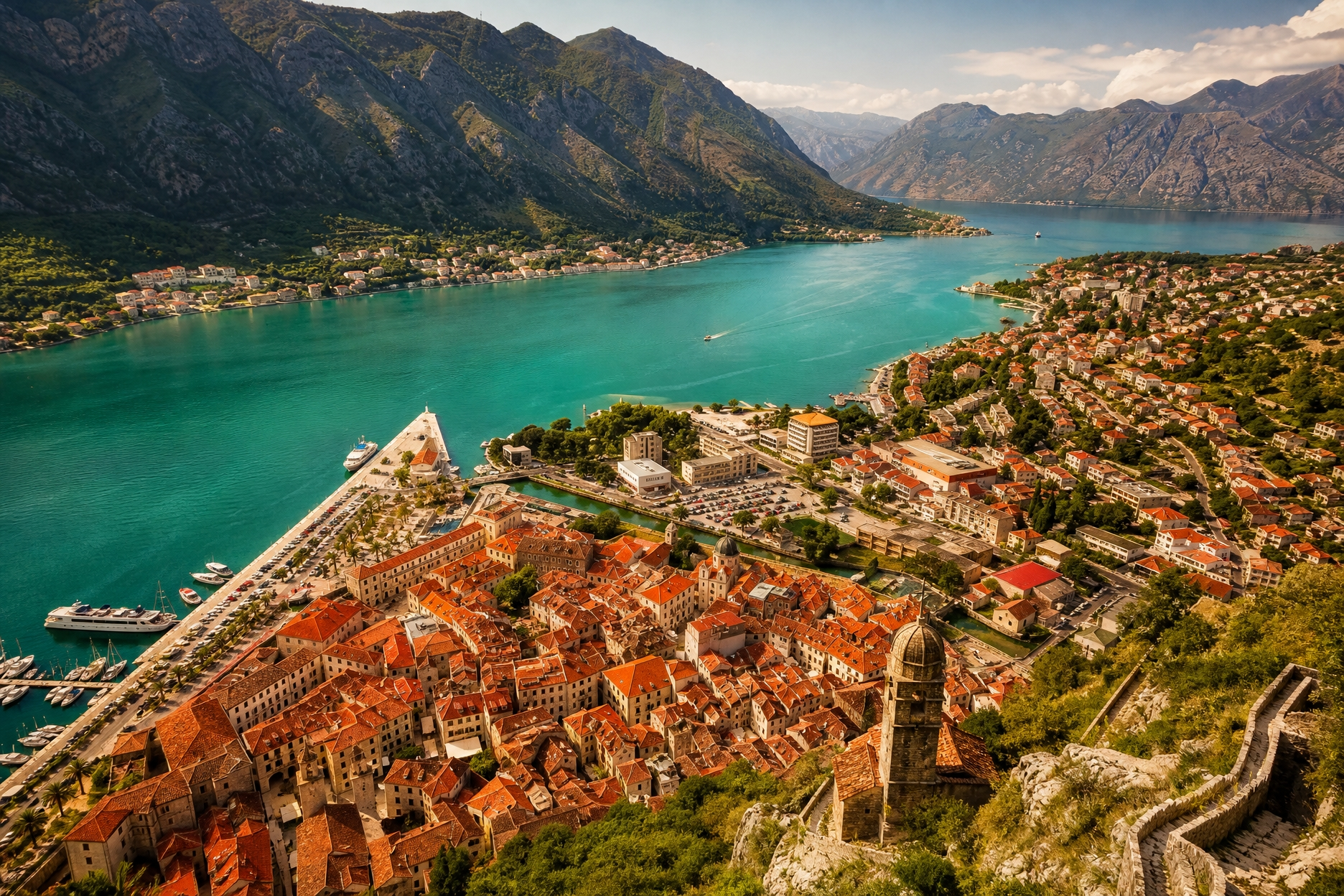
Montenegro packs a staggering amount of geography into 13,812 square kilometres — roughly the size of Connecticut. A coastline of 293 kilometres runs along the southern Adriatic, folding inward at the Bay of Kotor to form the deepest natural harbour in the Mediterranean and what many consider the most dramatic fjord-like inlet in southern Europe. Behind the coast, limestone mountains rise abruptly to nearly 2,000 metres, sheltering five national parks, one of Europe's last primeval forests, and the Tara River Canyon — the deepest gorge on the continent after Verd in France.
The country's name literally means "Black Mountain," a reference to the dark, densely forested peaks of Mount Lovćen that loom above the coast. Despite its small size, Montenegro has been a crossroads of empires: Venetian, Ottoman, Austro-Hungarian, and Yugoslav influences layer over each other in the architecture, food, and character of every town.
Tourism has surged. In 2025, Montenegro recorded 2.73 million arrivals and over 15.3 million overnight stays. The first half of 2026 added another 994,000 arrivals — up 5.7 percent year over year. Much of this growth is concentrated along the coast between Herceg Novi and Budva, but the mountains remain remarkably quiet. For a country this small, the contrast between a packed beach bar in Budva and total solitude on a Durmitor hiking trail two hours north is extraordinary.
Montenegro already uses the euro, which eliminates currency exchange hassles. Infrastructure is solid: roads are paved (if narrow), accommodation ranges from €20 hostels to Aman Resorts, and the food blends Adriatic seafood with hearty Balkan mountain cuisine. It is more expensive than Albania but significantly cheaper than Croatia, making it the sweet spot on the Adriatic coast for value and quality.
💡 Pro Tip
Montenegrins have a cultural concept called fjaka — the art of doing absolutely nothing, preferably over a long coffee. Do not rush through this country. Sit in a Kotor square, order a domaća kafa, and let an hour disappear. That is Montenegro at its best.
Best Time to Visit
Montenegro is a year-round destination, but the experience shifts dramatically between coast and mountains.
June and September are the sweet spot for the coast. The Adriatic reaches 22–24°C, air temperatures hover at 25–30°C, and the summer crush has not yet arrived or has just departed. Accommodation prices drop 30 to 40 percent from peak. September is particularly good — the sea holds its summer warmth, the light turns golden, and you can find a quiet beach even at Sveti Stefan.
July and August are peak season. Water temperatures hit 25–26°C, every beach bar and restaurant is open, and the coast buzzes with energy. The trade-off is real: Budva's Old Town is shoulder-to-shoulder, Kotor fills with cruise ship passengers by 10am, and hotel prices double. If you visit in peak season, base yourself in quieter towns like Perast, Tivat, or Herceg Novi rather than Budva.
May and October are excellent shoulder months. Great for the Bay of Kotor without crowds, road trips along the coast, and hiking as trails dry out (May) or the autumn colours arrive (October). The sea is swimmable in late May (20°C) and comfortable through mid-October (21°C).
November through April is off-season on the coast — many seaside hotels close. But the mountains come alive: Kolašin and Žabljak offer skiing from December through March at a fraction of Alpine prices. Podgorica stays mild (8–14°C) and is pleasant for a city break.
| Month | Water °C | Air °C | Crowds | Prices |
|---|---|---|---|---|
| Apr | 16 | 16–20 | Very low | Budget |
| May | 20 | 20–25 | Low | Budget–Mid |
| Jun | 22 | 25–30 | Moderate | Mid |
| Jul | 25 | 28–33 | High | Peak |
| Aug | 26 | 28–34 | Very high | Peak |
| Sep | 24 | 24–29 | Moderate | Mid |
| Oct | 21 | 18–23 | Low | Budget |
How to Get There
Flying In
Montenegro has two international airports. Podgorica Airport (TGD) is the capital's airport, with year-round flights to Belgrade, Istanbul, Vienna, London, and Rome via Air Montenegro, Ryanair, Wizz Air, Turkish Airlines, and others. It connects to 40+ destinations across 14 airlines.
Tivat Airport (TIV) is the coastal gateway, just 8 kilometres from Kotor. It operates primarily in summer with seasonal flights from London (easyJet, British Airways), major European hubs (Eurowings, Austrian, Jet2), and regional carriers. If the Bay of Kotor is your destination, fly into Tivat.
There are no direct flights from the United States or Canada. The most efficient routing is through Istanbul (Turkish Airlines), Vienna (Austrian Airlines), or London (easyJet to Tivat in summer).
Alternative entry points: Dubrovnik Airport (DBV) in Croatia is 45 minutes from the Montenegro border and 2 hours from Kotor. It often has cheaper and more frequent flights from North America and the UK. Many travellers fly into Dubrovnik and drive or bus south into Montenegro.
Getting Around by Car
A rental car is the single best way to experience Montenegro. The coastal road from Herceg Novi to Ulcinj is one of the most scenic drives in Europe, and the mountain roads to Durmitor and Biogradska Gora are accessible only by car or organised tour.
Rental prices start at €25 to €40 per day for a compact car. A few essential driving notes:
| Rule | Detail |
|---|---|
| Speed limits | 50 km/h urban, 80 km/h open road, 100–130 km/h motorway |
| Headlights | Dipped headlights required at all times, day and night, all year |
| Seat belts | Mandatory for all passengers |
| Blood alcohol | 0.03% — effectively zero tolerance |
| Tolls | Sozina Tunnel (Podgorica–coast shortcut): €3.50 one way |
⚠️ Heads Up
The road around the Bay of Kotor is narrow, winding, and heavily trafficked in summer. The Krstac serpentine road from Kotor to Cetinje has 25 hairpin turns with no guardrails in places. Drive slowly, use your horn on blind bends, and avoid these roads after dark.
Other Transport Options
| Transport | Route | Cost | Duration | Notes |
|---|---|---|---|---|
| Bus | Podgorica → Kotor | €8–12 | 2–2.5 hrs | Multiple daily departures |
| Bus | Kotor → Dubrovnik | €35–45 | 2–2.5 hrs | FlixBus and local operators, border crossing included |
| Ferry | Kotor → Dubrovnik | ~€50 | 3 hrs | Kompas catamaran, seasonal (summer) |
| Ferry | Kamenari → Lepetane | €4.50 (car) | 10 min | Bay of Kotor shortcut, runs every 15 min |
| Taxi | Tivat Airport → Kotor | €15–25 | 15 min | Agree on price before departure |
| Private transfer | Dubrovnik → Kotor | €60–100 | 1.5 hrs | Bookable via GetTransfer or hotel |
Where to Stay
Montenegro's accommodation ranges from €15 hostel dorms to €1,500-a-night luxury resorts. Here is a breakdown by area.
Kotor
The medieval walled town is the crown jewel. Stay inside the Old Town walls for atmosphere — stone guesthouses and boutique hotels occupy centuries-old buildings. Budget options run €40 to €70 per night, mid-range €80 to €140. Outside the walls, the Dobrota waterfront has quieter options at lower prices. Kotor is the best base for exploring the entire bay.
Perast
A tiny baroque village of 300 residents directly on the bay, 12 kilometres northwest of Kotor. No cars in the centre, no noise, just stone palaces, two island churches, and some of the best views in Montenegro. Hotels are intimate and mid-to-upper range: €80 to €180 per night. Perast is ideal for couples and anyone who wants the bay without the crowds.
Budva
The biggest resort town on the coast. Wide sandy beaches, a compact Old Town, and a relentless nightlife scene in summer. The widest range of accommodation in the country — from €20 hostels to €300+ beach resorts. Budva is best for travellers who want beach-and-party energy. It is the least "authentic" town on the coast but the most convenient for facilities.
Tivat
A modern marina town centred on Porto Montenegro, a luxury yacht marina. Tivat is quieter than Budva, close to the airport, and has good restaurants and waterfront cafes. Mid-range hotels run €60 to €130. A practical base if you are flying into Tivat Airport.
Herceg Novi
At the entrance to the Bay of Kotor, near the Croatian border. A hillside town with fortresses, lush vegetation, and a local feel that Budva has lost. Hotels and apartments run €35 to €90. Excellent value and a good base for day trips to Dubrovnik.
Žabljak and the Mountains
The gateway to Durmitor National Park. Small mountain town at 1,450 metres elevation. Guesthouses and small hotels run €30 to €70 per night. Essential base for hiking, rafting, and skiing. Book ahead in July–August for hiking season and January–February for skiing.
ℹ️ Good to Know
Booking tip: Kotor and Budva book out fast for July and August — reserve at least 4 to 6 weeks ahead. For June and September, 2 weeks is usually enough. Mountain accommodation is less competitive but limited in supply.
Things to Do
The Bay of Kotor
The bay is Montenegro's masterpiece — a flooded river canyon that winds 28 kilometres inland, flanked by mountains that rise to 1,749 metres directly from the waterline.
Kotor Old Town — A UNESCO World Heritage walled town with Venetian architecture, Romanesque churches, and cat-filled piazzas. Walk the city walls up to the Fortress of San Giovanni (1,350 steps) for a panoramic view that earns every drop of sweat. Best done early morning or late afternoon to avoid midday heat.
Perast and Our Lady of the Rocks — Take a €5 boat ride from Perast to this tiny man-made island where a baroque church sits atop a reef. Legend says fishermen laid stones here for 500 years to build the island. Entry to the church museum is €3.
The Bay Drive — The road from Kotor through Perast, Risan, and around to Herceg Novi is one of the most scenic short drives in Europe. Allow 2 to 3 hours with stops.
Beaches
Montenegro's coastline mixes sandy beaches, pebble coves, and dramatic rocky shores.
Sveti Stefan Beach — The most photographed spot in Montenegro: a fortified island village connected to the mainland by a narrow isthmus. The island itself is the ultra-exclusive Aman Sveti Stefan resort. The public beach flanks the isthmus — fine pink-grey sand, clear water, €25 for a sunbed in summer. Worth visiting even just for the views from the road above.
Mogren Beach — Two connected coves just west of Budva's Old Town, reached through a tunnel in the cliff. Fine sand, dramatic rock formations, and water so clear you can count pebbles at 5 metres.
Jaz Beach — A 1.2-kilometre sandy stretch 3 kilometres west of Budva. One of the best family beaches in Montenegro — wide, shallow entry, beach bars, and parking. Free entry; sunbed rental €10 to €15.
Ploče Beach — A cliffside beach club south of Budva with saltwater pools carved into the rocks, turquoise swimming areas, and a party atmosphere. Entry €15 to €25 including sunbed.
Lučice Beach — A hidden cove near Petrovac, sheltered by pines. Fine sand, calm water, no development. One of the most beautiful quiet beaches on the coast.
Velika Plaža (Long Beach) — A 13-kilometre unbroken sand beach near Ulcinj, one of the longest on the Adriatic. Kitesurfing capital of Montenegro.
Mountains and National Parks
Durmitor National Park — A UNESCO World Heritage site of 48 peaks above 2,000 metres, 18 glacial lakes, and the Tara River Canyon (1,300 metres deep, 82 kilometres long). Hike the circuit around Black Lake (Crno Jezero) — an easy 3.5-kilometre loop — or tackle the summit of Bobotov Kuk (2,523 metres, 8 hours return). Park entry is €5 per person.
Tara River Rafting — The signature Montenegro adventure. Raft 25 to 36 kilometres through Europe's deepest canyon on Class III–IV rapids surrounded by 1,000-metre limestone walls. Day trips from €65 per person, two-day trips with camping from €120. Season runs May to October.
Biogradska Gora — One of the last three primeval forests in Europe. A short, easy hike circles Biogradsko Lake through ancient beech and maple trees, some over 500 years old. Entry €5. Two hours from the coast.
Lovćen National Park — The "Black Mountain" that gave Montenegro its name. Drive or hike to the Njegos Mausoleum at 1,657 metres for a 360-degree panorama from the Adriatic coast to the Albanian mountains. The road from Kotor to Lovćen via the Krstac serpentines is legendarily dramatic.
Cetinje
The old royal capital of Montenegro, nestled in a mountain valley below Lovćen. A quiet town of monasteries, embassies-turned-museums, and wide boulevards built when Montenegro was a kingdom. Visit the Cetinje Monastery and the National Museum for a deep dive into Montenegrin identity.
Ulcinj
The southernmost town on the coast, near the Albanian border. Ulcinj has an Ottoman old town perched on a cliff above the sea, a large Albanian-speaking population, and the sprawling Velika Plaža. It feels distinct from the rest of coastal Montenegro — grittier, more multicultural, and far less touristic.
Costs and Budget
Montenegro uses the euro, which simplifies everything. ATMs are widely available; credit and debit cards are accepted at most hotels, restaurants, and shops in tourist areas. Cash is still useful at markets, smaller cafes, mountain guesthouses, and for parking meters.
Daily Budget Ranges
| Travel Style | Daily Cost (per person) | Includes |
|---|---|---|
| Budget | €40–65 | Hostel or budget guesthouse, bakery lunches and casual dinners, public buses, free beaches |
| Mid-range | €80–150 | Private hotel room, restaurant meals, rental car, beach clubs, a day tour |
| Comfort | €200–350+ | Boutique hotel or resort, fine dining, private transfers, guided excursions, Aman beach access |
Typical Prices (2026)
| Item | Cost |
|---|---|
| Burek (meat or cheese pastry) | €1.50–2.50 |
| Local restaurant meal | €7–12 |
| Mid-range restaurant dinner | €15–30 |
| Domaća kafa (traditional coffee) | €1.50–2.50 |
| Espresso | €1.50–2.50 |
| Pint of Nikšićko beer (bar) | €2.50–4.00 |
| Cocktail at a beach bar | €6–12 |
| Hostel dorm bed | €15–25/night |
| Budget guesthouse (double) | €40–70/night |
| Mid-range hotel (double) | €80–150/night |
| Boutique / resort | €150–400+/night |
| Rental car | €25–45/day |
| Petrol (1 litre) | €1.45–1.65 |
| Podgorica → Kotor bus | €8–12 |
| Kotor → Dubrovnik bus | €35–45 |
| Durmitor park entry | €5 |
| Tara River rafting (day) | €65–90 |
💡 Pro Tip
Save money: Eat at konobas (traditional family-run taverns) rather than waterfront tourist restaurants — the food is better and 30 to 50 percent cheaper. Base yourself in Herceg Novi or Tivat instead of Kotor or Budva for lower accommodation prices. Visit in June or September to avoid peak-season markups.
Essential Tips
Money
Montenegro uses the euro despite not being an EU member. This is a massive convenience — no currency exchange needed if you are coming from the eurozone. ATMs dispense euros and are common in all towns. Visa and Mastercard are widely accepted; Amex less so. A travel card with no foreign transaction fees (Wise or Revolut) is ideal for non-eurozone visitors.
Language
The official language is Montenegrin, which is mutually intelligible with Serbian, Bosnian, and Croatian — they are effectively the same language with minor vocabulary differences. English is widely spoken in tourist areas, especially by younger Montenegrins. Italian is understood along parts of the coast due to historical Venetian influence. Learning Hvala (thank you) and Dobar dan (good day) is appreciated.
Safety
Montenegro is very safe for travellers. Violent crime against tourists is rare. The country is broadly considered safer than most western European cities. The primary risks are practical rather than criminal.
Driving is the biggest concern. Coastal roads are narrow and winding, local drivers are aggressive, and some mountain roads lack guardrails. The Kotor serpentines, the Krstac road, and the Durmitor mountain passes require full concentration. Do not drive mountain roads at night.
Cruise ship days in Kotor bring 3,000 to 8,000 visitors for a few hours, overwhelming the tiny Old Town. Check the Kotor cruise ship schedule online and plan Old Town visits for early morning, late afternoon, or non-cruise days.
Swimming safety: Most beaches are unguarded. The Adriatic is generally calm, but currents can develop around headlands and at river mouths. Respect local warnings.
Connectivity
A local SIM card from One (Crnogorski Telekom) costs €5 to €8 with 5 to 10GB of data. Coverage is good along the coast and in cities but drops in mountain valleys and national parks. Alternatively, buy an eSIM from Airalo, Saily, or Yesim before you arrive — it activates instantly on landing. Free Wi-Fi is available in most hotels, cafes, and restaurants. For a detailed comparison, see our Best eSIM for the Balkans guide.
Food to Try
Montenegrin cuisine splits between Adriatic seafood on the coast and hearty mountain food inland. Do not leave without trying:
Njeguški pršut — Dry-cured ham from the village of Njeguši above Kotor, smoked with beechwood and mountain herbs. Arguably the best cured meat in the Balkans. Often served with Njeguški sir (smoked cheese) as a starter.
Buzara — Mussels or prawns cooked in white wine, garlic, olive oil, and breadcrumbs. A coastal staple best eaten at a harbourside konoba with crusty bread to soak up the sauce.
Ispod sača — Meat (usually lamb or veal) and vegetables slow-roasted for hours under a metal bell covered with hot coals. A mountain tradition that produces impossibly tender, smoky meat. Must be ordered in advance at most restaurants.
Kačamak — A thick cornmeal porridge mixed with mashed potato, kajmak (clotted cream), and cheese. The mountain equivalent of comfort food. Served at traditional restaurants in Kolašin and Žabljak.
Crni rižoto — Black risotto made with cuttlefish ink, a Dalmatian and Montenegrin coastal classic. Rich, briny, and dramatic on the plate.
Priganice — Fried dough balls dusted with sugar or drizzled with honey, served for breakfast or as a snack. Simple and addictive.
Getting Around Within Montenegro
A rental car is the most flexible option and the only practical way to reach the mountains, quieter beaches, and scenic routes like the Kotor serpentines. Compact car rates start at €25 per day from Podgorica or Tivat airports. Book through GetRentacar or Localrent for local agency options that often beat international brands on price.
Buses connect all major towns. The Podgorica–Kotor and Podgorica–Budva routes run frequently. Intercity buses are comfortable and affordable (€5 to €15 for most routes). For cross-border travel, FlixBus operates the Kotor–Dubrovnik route.
Ferries operate two key services: the Kamenari–Lepetane car ferry across the Bay of Kotor (€4.50 per car, runs every 15 minutes, saves an hour of driving around the bay) and the seasonal Kotor–Dubrovnik catamaran.
Taxis are available in all towns but agree on the fare before getting in — meters are not always used. Bolt works in Podgorica only.
Packing Essentials
Bring good walking shoes — Kotor's Old Town and fortress are cobblestone, and mountain trails demand proper footwear. A light rain jacket is useful even in summer as afternoon thunderstorms roll in quickly from the mountains. Sunscreen and a hat are essential on the coast from May to September. Pack layers if you plan to visit the mountains — temperatures at 1,500 metres can be 10 to 15°C cooler than the coast. A universal power adapter (Type C/F) if coming from the US, UK, or Australia.
ℹ️ Good to Know
Visa note: US, EU, UK, Canadian, and Australian citizens can enter Montenegro visa-free for up to 90 days in any 180-day period. Your passport must be valid for the duration of your stay. EU citizens can also enter with a national ID card. If combining Montenegro with neighbouring countries, track your total days carefully — Montenegro is not in the Schengen zone, so the 90-day clock is separate.
Montenegro is a country that defies its size. You can swim in the Adriatic before breakfast, drive through a 1,300-metre-deep canyon by lunch, and hike a glacial lake ringed by 2,000-metre peaks before dinner — and still be back at a harbourside table for fresh buzara and a glass of Vranac by sunset. It is the Balkans compressed into one extraordinary sliver of coast and mountain. Visit before the cruise ships and resort developments finish the transformation that is already well underway.
For a detailed road trip itinerary, read our Montenegro Road Trip: Coast to Mountains. For transport between Montenegro and Croatia, see Kotor to Dubrovnik: All Transport Options.
More Montenegro Guides
Guide
How Much Does Albania Really Cost?
Real 2026 prices for Albania: accommodation, food, transport, beaches and activities, plus sample budgets for one week on the Riviera and inland.
Guide
Albanian Riviera on a Budget: Daily Costs 2026
A line-by-line breakdown of what the Albanian Riviera actually costs in 2026 — accommodation, food, beaches, transport, and activities at every budget level. Real prices from Himara to Ksamil, with tested strategies to keep your daily spend under €50.
Guide
Bay of Kotor Day Trip: Complete Guide
A complete day trip guide to the Bay of Kotor in 2026 — Kotor Old Town, the fortress hike, Perast, Our Lady of the Rocks, the cable car, and the hidden villages along the bay. Hour-by-hour itinerary, real costs, and timing that avoids cruise ship crowds.
Guide
Best Car Rental in Montenegro (Tested)
A tested comparison of car rental companies in Montenegro for 2026 — international chains vs. local agencies, real prices from Tivat and Podgorica airports, insurance explained without jargon, cross-border rules for Croatia and Albania, and the three self-drive routes that justify the rental cost.