📋 Quick Facts
| Detail | Info |
|---|---|
| Currency | Euro (€). Slovenia adopted the euro in 2007 — no currency exchange needed. |
| Language | Slovenian. English widely spoken, especially by younger generations. |
| Visa | US/UK/Canada/Australia: 90 days visa-free (Schengen). EU citizens: unlimited with ID card. ETIAS expected late 2026 for visa-exempt nationals. |
| Power Plug | Type C and F (two round pins, 230V/50Hz). Bring an adapter if coming from the US or UK. |
| Tap Water | Safe to drink everywhere — Slovenia has some of the cleanest tap water in Europe. |
| Emergency | 112 |
| SIM / eSIM | Telekom Slovenije or A1 prepaid SIM from €7. eSIM via Airalo from €4.50. |
| Best Months | May–June and September — warm, dry, fewer crowds, lower prices. |
Overview
Slovenia is a country that defies its size. At just 20,271 square kilometres — roughly the size of New Jersey — it manages to contain the Julian Alps, a 46-kilometre Adriatic coastline, one of the world's most famous cave systems, rolling wine country that rivals Tuscany, and a capital city that regularly tops Europe's green-living rankings. The population is only 2.1 million, which means that even in the peak of summer, you are rarely more than a short drive from genuine solitude.
The country sits at a geological crossroads where the Alps, the Mediterranean, the Pannonian plain, and the Dinaric karst converge. This means that within two hours of Ljubljana you can be swimming in the Adriatic, standing on a 2,864-metre summit, tasting orange wine in a centuries-old cellar, or walking through a cave system that stretches 24 kilometres underground. Few places in Europe offer this kind of density.
Slovenia joined the EU in 2004, adopted the euro in 2007, and has quietly built one of the highest standards of living in Central Europe. Infrastructure is excellent: roads are well-maintained, trains run on time, and public spaces are clean. Prices sit comfortably below Western Europe — a full restaurant meal costs €10 to €20, a good hotel room runs €60 to €120, and a coffee in Ljubljana is €1.50 to €2.50 — while quality of service often matches Austria or northern Italy.
Tourism has grown steadily, but Slovenia has been deliberate about managing it. Ljubljana was named European Green Capital in 2016, and the country markets itself under the "I Feel Slovenia" brand with an emphasis on sustainability. Overtourism is a concern only at Lake Bled in July and August; everywhere else, even in peak season, the experience feels uncrowded and authentic.
For travellers exploring the Balkans, Slovenia works beautifully as a first or last stop — it shares borders with Italy, Austria, Hungary, and Croatia, and its compact size means you can see the highlights in five to seven days while still feeling unhurried.
💡 Pro Tip
Slovenia is the only country in the world with "love" in its name — sLOVEnia. It is also the only European country where a brown bear population still roams freely in the southern forests. You probably will not see one, but you might.
Best Time to Visit
Slovenia is a four-season destination, and each season has a distinct character.
May and June are the sweet spot. Days are long and warm (20–26°C), wildflowers blanket the alpine meadows, Lake Bled is swimmable by late May, and accommodation prices stay 20 to 30 percent below peak. June is especially good: trails in Triglav National Park are fully open, the coast is warm enough for swimming, and the summer crowds have not yet arrived.
July and August are peak season. Temperatures reach 28–33°C in Ljubljana and along the coast, the Adriatic hits 24–26°C, and Lake Bled is at its warmest. The trade-off is higher prices, crowded viewpoints at Bled and Bohinj, and sold-out accommodation at top hotels. Book at least four to six weeks ahead if visiting in peak summer.
September and early October offer a second window. Temperatures cool to a comfortable 18–25°C, autumn colours begin in the Julian Alps, and the wine harvest is in full swing in Goriška Brda and the Vipava Valley. The sea remains swimmable into October (20–22°C). Tourist numbers drop noticeably after the first week of September.
November through March is the off-season for most of the country, but the peak season for skiing. Kranjska Gora and Vogel are Slovenia's main ski resorts, with lift passes running €35 to €50 per day. Ljubljana is atmospheric in December with Christmas markets, and cave visits are uncrowded.
| Month | Sea °C | Air °C | Crowds | Prices |
|---|---|---|---|---|
| Apr | 14 | 14–18 | Very low | Budget |
| May | 18 | 18–23 | Low | Budget–Mid |
| Jun | 22 | 22–27 | Moderate | Mid |
| Jul | 25 | 26–30 | High | Peak |
| Aug | 26 | 26–33 | Very high | Peak |
| Sep | 23 | 20–25 | Moderate | Mid |
| Oct | 20 | 14–19 | Low | Budget |
How to Get There
Flying In
Slovenia's only major airport is Ljubljana Jože Pučnik Airport (LJU), located 25 kilometres north of the capital. Direct flights connect to London, Munich, Frankfurt, Istanbul, Paris, Brussels, Amsterdam, and Zürich, among others. Budget carriers like Wizz Air and easyJet serve several routes, with fares as low as €30 to €60 one way if booked early.
There is no direct flight from the United States or Canada. The most efficient routings are through Istanbul (Turkish Airlines), Frankfurt (Lufthansa), or Munich (Lufthansa or Eurowings).
A practical alternative for travellers combining Slovenia with neighbouring countries is to fly into Venice Marco Polo (VCE) or Trieste (TRS) in Italy, or Zagreb (ZAG) in Croatia, and travel overland. Venice to Ljubljana is about 2.5 hours by bus or car; Zagreb to Ljubljana is about 2 hours by train.
Getting from the Airport to Ljubljana
| Transport | Route | Cost | Duration | Notes |
|---|---|---|---|---|
| Public bus (Line 28) | Airport → Ljubljana bus station | €4–5 | 45–50 min | Every 30–60 min, buy from driver |
| Shared shuttle | Airport → Ljubljana centre | €12–16 | 30–40 min | Book online in advance |
| Taxi | Airport → Ljubljana centre | €35–45 | 25–30 min | Fixed rate from official stand |
| Shared shuttle | Airport → Lake Bled | €18–25 | 35–45 min | Book in advance, seasonal schedules |
| Taxi | Airport → Lake Bled | €60–80 | 35–45 min | Negotiate or pre-book |
Getting Around by Train and Bus
Slovenia's rail and bus networks are compact and reliable. Key intercity routes:
| Route | Transport | Cost | Duration | Notes |
|---|---|---|---|---|
| Ljubljana → Lake Bled | Bus | €7–8 | 75 min | Frequent departures |
| Ljubljana → Piran | Bus | €11–13 | 2.5 hrs | Direct service via motorway |
| Ljubljana → Postojna | Train or bus | €5–8 | 1 hr | Good connections for cave day trips |
| Ljubljana → Maribor | Train | €10–16 | 2–2.5 hrs | IC train is fastest |
| Ljubljana → Bovec (Soča Valley) | Bus | €12–15 | 3.5 hrs | Limited departures, check timetable |
💡 Pro Tip
If you plan to explore beyond Ljubljana and Bled, rent a car. Slovenia is tiny — you can cross the entire country in under three hours — and a car unlocks the Vipava wine valley, the Soča Valley, and mountain passes that buses do not serve well. Rates start at €25 to €35 per day for a compact car. A vignette (motorway toll sticker) costs €16 for a week and is mandatory for all motorways. Buy it at the border, airport, or any petrol station.
Where to Stay
Slovenia offers accommodation for every budget, from €13 hostel dorms to €220+ boutique hotels. Here is a breakdown by region.
Ljubljana
The capital is compact and walkable, and most visitors spend one to three nights here. The Old Town and Metelkova areas are the most convenient bases. Hostel dorms run €15 to €30 per night. Well-reviewed mid-range hotels like Hotel Cubo or Vander Urbani Resort cost €100 to €160. For budget private rooms, look at apartments in the Trnovo neighbourhood — charming, quiet, and a 10-minute walk to the centre at €50 to €80 per night.
Lake Bled and Lake Bohinj
Bled is Slovenia's most popular destination, and prices reflect it. In July and August, expect €80 to €150 for a mid-range double room, and budget guesthouses fill up fast. A smarter move is to stay in Bohinjska Bistrica (15 minutes from Bled), where similar-quality rooms cost 30 to 40 percent less. Lake Bohinj itself is quieter, greener, and more dramatic — apartments here run €50 to €90 per night in summer.
Piran and the Coast
Slovenia's 46-kilometre Adriatic coastline centres on the Venetian-influenced towns of Piran, Izola, and Koper. Piran's old town is the star — narrow alleys, terracotta roofs, and Tartini Square. Accommodation in the old town core is limited and books early: expect €70 to €130 for a good apartment in summer. Portorož, the adjacent resort town, has larger hotels from €90 to €180 but less character. Izola is the budget-friendly alternative at €50 to €90.
Soča Valley
Bovec and Kobarid are the main bases for Slovenia's adventure region. Guesthouses and small hotels run €50 to €100 per night. This area books up for July and August; reserve at least a month ahead. Camping is popular and affordable — well-equipped campsites start at €15 to €25 per pitch.
Maribor and Eastern Slovenia
Slovenia's second city is often overlooked by tourists, which means excellent value. Clean, comfortable hotels in the centre cost €50 to €90 per night. The Maribor wine road, Ptuj (Slovenia's oldest town), and the thermal spas of Prekmurje are all within easy reach.
ℹ️ Good to Know
Booking tip: Bled and Piran book out fast for July and August. Reserve at least 4 to 6 weeks ahead for peak season. For September, 2 to 3 weeks is usually sufficient. Ljubljana has more capacity and rarely sells out completely.
Things to Do
Lake Bled
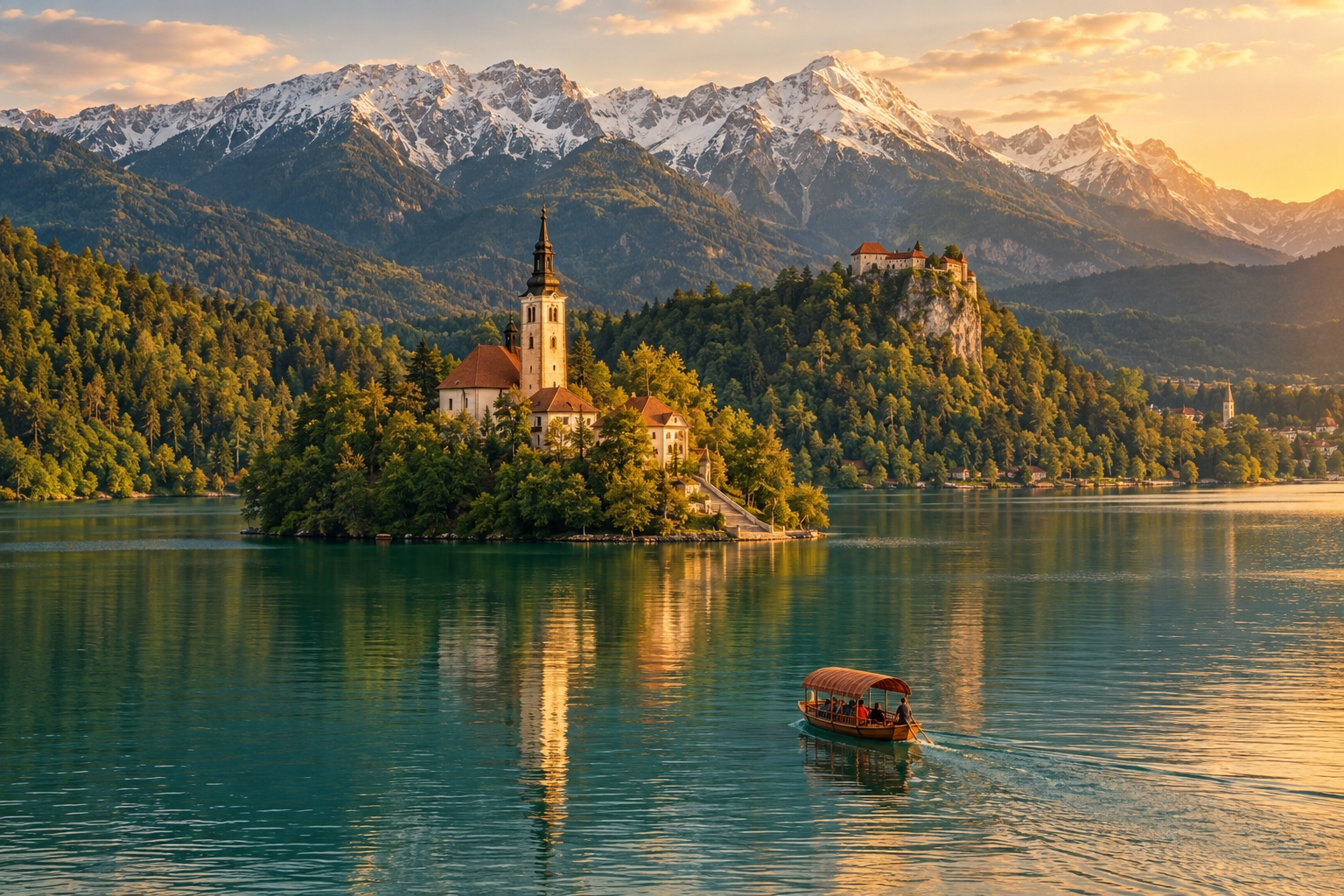
The postcard shot of a church on a tiny island, a medieval castle on a cliff, and snow-capped Alps behind is not exaggerated — Lake Bled really looks like that. Take a pletna boat (€20 per adult, round trip) to the island and ring the wishing bell. Walk or cycle the 6-kilometre lakeside path. Hike up to Mala Osojnica for the best overhead viewpoint (free, 20-minute steep climb). And do not leave without trying kremna rezina (cream cake) — the local obsession since 1953, best at the Park Hotel patisserie.
Lake Bohinj and Triglav National Park
If Bled is the polished greeting card, Bohinj is the wilder, quieter sibling. Slovenia's largest natural lake sits inside Triglav National Park — the country's only national park, and it is free to enter. Hike to Savica Waterfall (€5 entry), ride the cable car up Vogel (€22 return) for panoramic views of the Julian Alps, or swim in the lake's pristine water. Serious hikers can attempt the ascent of Mount Triglav (2,864m), Slovenia's highest peak and a national symbol — it appears on the flag.
Postojna Cave and Predjama Castle
Postojna Cave is one of the most visited caves in Europe: 24 kilometres of passages, a miniature electric train ride, and a famous population of olms (blind cave salamanders). Adult tickets cost €30.90 in peak season, €27.90 off-season. A combined ticket with Predjama Castle — a jaw-dropping fortress built into a 123-metre cliff face — costs €38, saving about €8 versus buying separately. If you prefer a less commercial experience, Škocjan Caves (a UNESCO World Heritage Site, 30 minutes southeast) offer a more dramatic underground canyon at €20 to €24 per adult.
Piran and the Coast
Piran is a tiny, perfect Venetian town jutting into the Adriatic. Wander the narrow streets, climb the cathedral bell tower for coastal views, swim off the Punta promenade, and eat fresh seafood at harbourside restaurants. The salt pans of Sečovlje (€8 entry) south of Piran are a peaceful nature reserve and working saltworks dating to the 14th century.
The Soča Valley
The Soča River is famous for its impossible emerald colour. Bovec and Kobarid are the activity hubs: rafting (€45–70), canyoning (€50–80), kayaking, and zip-lining. The Kobarid Museum (€8) is one of the best World War I museums in Europe, covering the 1917 Battle of Caporetto. The valley is also excellent for fly-fishing — the Soča is home to the endemic marble trout.
Ljubljana
Walk the old town along the Ljubljanica River, cross the Triple Bridge and Dragon Bridge, ride the funicular to Ljubljana Castle (funicular return €6, castle exhibits €19), and browse the open-air Central Market designed by Jože Plečnik. In the evening, explore the alternative cultural hub of Metelkova — a former military barracks turned into galleries, bars, and street art.
Wine Country
Slovenia's Goriška Brda region — sometimes called the Slovenian Tuscany — produces exceptional wine, including the increasingly famous orange wines made from the Rebula grape using ancient skin-contact methods. The Vipava Valley and the Karst region are equally rewarding, with wine tastings running €10 to €25. A self-drive wine tour through Brda's hilltop villages is one of the best half-day experiences in the country.
Costs and Budget
Slovenia uses the euro, so there is no currency exchange to manage. Prices sit below Western Europe but above most of Southeast Europe — think roughly 70 to 80 percent of Austrian prices. Cards are accepted almost everywhere, but carry some cash for small gostilne (local taverns), mountain huts, and market stalls.
Daily Budget Ranges
| Travel Style | Daily Cost (per person) | Includes |
|---|---|---|
| Budget | €45–60 | Hostel dorm or budget guesthouse, supermarket meals + one gostilna dinner, public buses, free attractions |
| Mid-range | €100–130 | 3-star hotel or apartment, two sit-down meals, car rental or trains, one paid attraction per day |
| Comfort | €160–200+ | Boutique hotel, restaurant dining with local wine, private tours, guided adventures |
Typical Prices (2026)
| Item | Cost |
|---|---|
| Espresso | €1.50–2.50 |
| Pint of local beer (bar) | €3.50–5.00 |
| Glass of local wine | €3–6 |
| Lunch at a gostilna | €10–16 |
| Mid-range restaurant dinner (per person) | €20–35 |
| Kremna rezina at Lake Bled | €4–5 |
| Hostel dorm bed | €15–30/night |
| Budget guesthouse (double) | €50–80/night |
| Mid-range hotel (double) | €80–150/night |
| Boutique hotel | €150–220+/night |
| Rental car (compact) | €25–45/day |
| Petrol (1 litre) | €1.55–1.70 |
| Motorway vignette (7 days) | €16 |
| Ljubljana → Bled bus | €7–8 |
| Ljubljana → Piran bus | €11–13 |
| Postojna Cave (adult, peak) | €30.90 |
| Postojna + Predjama combo | €38 |
| Škocjan Caves (adult) | €20–24 |
| Pletna boat to Bled Island | €20 |
| Vintgar Gorge (adult) | €10 |
| Ljubljana Castle + funicular | €19 |
| SIM card (tourist, prepaid) | €7–10 |
💡 Pro Tip
Save money: Eat at local gostilne (traditional taverns) a few streets away from the main tourist spots — the food is better and the prices can be 30 percent lower. Choose Škocjan Caves over Postojna for a cheaper, less crowded, and arguably more dramatic experience. Stay in Bohinjska Bistrica instead of Bled for similar lake access at a fraction of the cost. Travel in May–June or September for lower prices and fewer crowds.
Essential Tips
Money
Slovenia is a euro country, and cards (Visa, Mastercard) are accepted at nearly all hotels, restaurants, and shops. Contactless payment is widespread. Still, carry €30 to €50 in cash for small gostilne, mountain huts, market vendors, and parking meters. ATMs are widely available and dispense euros. A travel-friendly card with no foreign transaction fees (like Wise or Revolut) is the best way to manage money.
Language
Slovenian is a South Slavic language with a small number of speakers — only about 2.5 million worldwide. Despite this, most Slovenians in tourism, hospitality, and urban areas speak excellent English. Italian is understood along the coast, and German in the northern Alpine region. Learn a few phrases — Hvala (hvah-lah, thank you) and Dober dan (good day) will earn genuine smiles.
Safety
Slovenia is one of the safest countries in Europe. Violent crime is extremely rare, and petty crime (pickpocketing) is uncommon even by European standards. The main practical risks are mountain weather (conditions in the Julian Alps can change rapidly — bring layers and check forecasts before hiking) and wildlife (brown bears live in the southern Kočevje forests but encounters are extremely rare and bears avoid humans). Road conditions are excellent on motorways but mountain passes can be narrow and steep — drive cautiously, especially Vršič Pass.
Connectivity
Telekom Slovenije and A1 both offer prepaid tourist SIM cards from €7 to €10 with 10GB of data. Coverage is strong across the country, including most mountain valleys. If you prefer not to swap SIMs, buy an eSIM from Airalo or Saily before you arrive — your data will work the moment you land. Free Wi-Fi is available in most cafes, hotels, and Ljubljana's city centre. For more details, see our Best eSIM for the Balkans guide.
Food to Try
Slovenian cuisine sits at a crossroads of Alpine, Mediterranean, and Pannonian traditions, and the result is more varied than you might expect. Do not leave without trying idrijski žlikrofi (small herbed potato dumplings from the town of Idrija — the first Slovenian dish to receive EU protected status), štruklji (rolled dumplings filled with cottage cheese, walnuts, or tarragon), jota (a hearty sauerkraut and bean stew from the Karst), kranjska klobasa (the Carniolan sausage — Slovenia's most famous meat), and potica (a rolled nut bread served at celebrations). For dessert, kremna rezina at Lake Bled and prekmurska gibanica (a layered pastry of poppy seeds, walnuts, apples, and cottage cheese) are both essential. Wash it all down with Slovenian wine — the country produces exceptional whites and increasingly celebrated orange wines from the Goriška Brda region.
Getting Around Within Slovenia
Slovenia's compact size is its superpower. Ljubljana to Lake Bled is 55 kilometres. Ljubljana to Piran is 120 kilometres. Ljubljana to Bovec is 130 kilometres. You can genuinely reach any corner of the country in under three hours.
A rental car is the best way to explore. It unlocks wine country, mountain passes like Vršič, and smaller towns that bus schedules do not serve well. Rates start at €25 to €35 per day for a compact car. A weekly motorway vignette (€16) is mandatory for all vehicles on the motorway system — buy it at the border, the airport, or any petrol station before you get on the motorway, or risk a €300 fine.
Without a car, trains cover the main Ljubljana–Maribor and Ljubljana–Koper corridors reliably. Buses are the better option for Bled, Bohinj, Piran, and the Soča Valley — they run frequently and cost €5 to €15 for most routes. There is no Uber in Slovenia; the GoOpti shuttle service is useful for airport transfers and intercity travel if booked in advance.
Packing Essentials
Bring good walking shoes — cobblestones in Ljubljana, hiking trails at Bled and Triglav, and gravel paths in wine country demand something sturdier than flip-flops. A rain jacket is essential even in summer — afternoon thunderstorms are common in the mountains. A reusable water bottle will save money since tap water is excellent. And a universal power adapter (Type C/F) if you are coming from the US, UK, or Australia.
ℹ️ Good to Know
Visa note for US citizens: Slovenia is a Schengen Area member. US, UK, Canadian, and Australian citizens can stay up to 90 days within any 180-day period without a visa. Your passport must be valid for at least three months beyond your planned departure. EU citizens can enter with a national ID card. The ETIAS travel authorisation system is expected to launch in late 2026 — check current requirements before booking.
Slovenia is the rare European country that delivers on every promise it makes. The lakes are that blue, the caves are that dramatic, the food is that good, and the people are that welcoming. It is small enough to see in a week and rich enough to keep you coming back. If you are planning a Balkans trip and have not put Slovenia on the itinerary yet, fix that now — it may be the most rewarding stop on the entire route.
For travel insurance options, see our Best Travel Insurance for the Balkans guide. For staying connected on the road, check our Best eSIM for the Balkans comparison.