Destination Guide
Bosnia & Herzegovina Travel Guide
📋 Quick Facts
| Detail | Info |
|---|---|
| Currency | Convertible Mark (BAM / KM). €1 = 1.96 KM (fixed peg). Cash-heavy — carry BAM everywhere. |
| Language | Bosnian, Croatian, Serbian (mutually intelligible). English spoken in tourist areas. |
| Visa | US citizens: 90 days visa-free within 6 months. EU/UK/Canada/Australia: 90 days visa-free. |
| Power Plug | Type C and F (two round pins, 230V). US and UK travellers need an adapter. |
| Tap Water | Generally safe in cities (Sarajevo, Mostar). Stick to bottled in rural areas. |
| Emergency | 112 |
| SIM / eSIM | BH Telecom tourist SIM from ~€5 (data only). eSIM via Airalo from €4.50. Cash often needed to buy SIM. |
| Best Months | May, June, and September — warm, dry, fewer crowds, lower prices. |
Overview
Bosnia and Herzegovina is the Balkans without the filter. Where Croatia has polished its coastline for package tourists and Montenegro courts luxury yachts, Bosnia remains raw, complicated, and deeply rewarding. It is the country in the region that most challenges you — and most surprises you.
The landscape is dramatic: emerald rivers carve through limestone canyons, forested mountains rise steeply from valley floors, and a single 9-kilometre sliver of Adriatic coastline at Neum is the country's entire access to the sea. The Ottoman Empire left behind stone bridges, copper bazaars, and a coffee ritual that Bosnians take more seriously than almost anything else. The Austro-Hungarian period added grand civic buildings and a European cafe culture that still defines Sarajevo's boulevards.
And then there is the war. The 1992–1995 siege of Sarajevo, the destruction of Mostar's Old Bridge, and the Srebrenica genocide are not distant history — they are living memory. Bullet holes still mark apartment facades. War museums are not dusty archives but urgent, emotionally devastating spaces. Bosnia does not hide its scars, and travellers who engage with that history leave with a deeper understanding of both the country and the fragility of peace.
What softens all of this is the warmth. Bosnians are famously hospitable — offer you coffee before you have finished asking a question, press homemade rakija into your hands, and refuse to let you pay for anything. The food is heavy, honest, and absurdly cheap. A plate of ćevapi with bread, onion, and kajmak costs €3. A private room in a guesthouse runs €20 to €35 a night. A bus from Sarajevo to Mostar is €10. For travellers looking for substance over polish, Bosnia is the strongest proposition in the Balkans.
💡 Pro Tip
Bosnia and Herzegovina is not in the EU and not in the Schengen Area. Time spent here does not count toward your 90-day Schengen limit. This makes it an ideal break in the middle of a longer European trip to "reset" your Schengen clock.
Best Time to Visit
Bosnia has a Continental climate — genuine seasons with cold winters and warm summers. The mountains amplify everything: hotter highs, colder lows, and more rain than the Adriatic coast next door.
May, June, and September are the sweet spot. Daytime temperatures sit at 22–28°C, rain is infrequent, and the river canyons and waterfalls are at their most beautiful. Tourism is growing but remains modest — you will not face the crushing crowds that hit Dubrovnik or Hvar. September is especially good: warm, golden light, and late-season produce at its peak.
July and August are peak season — the warmest months (28–35°C) and when most international visitors arrive. Mostar and Sarajevo's old towns get busy. Accommodation prices rise 20 to 30 percent. The rivers are ideal for rafting, and Kravica Waterfall is swimmable. If you visit in midsummer, start sightseeing early and book ahead for popular guesthouses.
April and October are shoulder months. Great for city exploration and hiking. Temperatures range from 14 to 22°C. Some outdoor attractions (Una National Park, rafting tours) may have limited operations at the edges of the season.
November through March is winter. Sarajevo regularly sees snow, and temperatures drop below freezing. The city is atmospheric in the cold — the smell of wood smoke, warm ćevapi, and Bosnian coffee take on a different character. The mountains around Sarajevo have modest ski resorts (Jahorina and Bjelašnica hosted the 1984 Winter Olympics). Mostar and the south stay milder but quieter.
| Month | Air °C | Rain | Crowds | Prices |
|---|---|---|---|---|
| Apr | 14–18 | Moderate | Very low | Budget |
| May | 18–24 | Low | Low | Budget |
| Jun | 22–28 | Low | Moderate | Mid |
| Jul | 26–33 | Low | High | Mid–Peak |
| Aug | 26–35 | Low | High | Mid–Peak |
| Sep | 20–26 | Low | Moderate | Mid |
| Oct | 14–20 | Moderate | Low | Budget |
How to Get There
Flying In
Bosnia has two airports that handle most international traffic: Sarajevo (SJJ) and Tuzla (TZL). Sarajevo has direct flights from Frankfurt, Vienna, Istanbul, London (Luton), Stockholm, Zurich, and Ljubljana. Tuzla is a Wizz Air hub with budget routes from several European cities.
There are no direct flights from the United States, Canada, or Australia. The most efficient routing is through Istanbul (Turkish Airlines), Vienna (Austrian Airlines), or Frankfurt (Lufthansa). Budget travellers often fly into Dubrovnik (Croatia) or Split (Croatia) and take a bus across the border — Dubrovnik to Mostar is 4 to 5 hours by bus.
Getting from Sarajevo Airport to the city: The airport bus runs every 90 minutes for €2.50. The trolleybus 103 costs €0.90 and takes 30 minutes. A taxi to the centre costs €10 to €15 — insist the meter is running or agree a price beforehand.
Overland from Neighbouring Countries
Bosnia is frequently combined with Croatia and Montenegro on a wider Balkans trip. The borders are straightforward — passport check, not just a wave-through — but crossings are generally quick outside of summer weekends.
| Route | Transport | Cost | Duration | Notes |
|---|---|---|---|---|
| Dubrovnik → Mostar | Bus | €13–18 | 4–5 hrs | Via Neum corridor (2 border crossings). Bring passport. |
| Split → Mostar | Bus | €13–16 | 3.5 hrs | Frequent service, comfortable coaches. |
| Split → Sarajevo | Bus | €20–25 | 5–6 hrs | Via Mostar. |
| Zagreb → Sarajevo | Bus | €25–30 | 7–8 hrs | Long ride; consider flying. |
| Kotor → Mostar | Car/transfer | €60–90 | 2.5 hrs | No direct bus. Private transfer or rental car. |
| Belgrade → Sarajevo | Bus | €20–28 | 6–8 hrs | Multiple daily departures. |
💡 Pro Tip
Bosnia is an excellent Schengen clock reset. If you have been in Schengen countries (Croatia, Greece, Italy, etc.) and are approaching your 90-day limit, crossing into Bosnia stops the clock. Bosnia, Serbia, Montenegro, Albania, and North Macedonia are all non-Schengen — you can spend time in any of them without affecting your Schengen allowance.
Where to Stay
Accommodation is where Bosnia's value really shines. Even mid-range properties cost a fraction of what you would pay across the border in Croatia, and the quality is consistently good.
Sarajevo
The capital has the widest range of accommodation. Baščaršija (the Ottoman old town) is the most atmospheric base — cobblestone lanes, the smell of ćevapi, and the call to prayer at dawn. Guesthouses and small hotels here run €30 to €65 per night. The Austro-Hungarian quarter (along Ferhadija) is more polished, with mid-range hotels at €50 to €90. Hostels are excellent and plentiful: €7 to €15 for a dorm bed, €15 to €30 for a private double.
Mostar
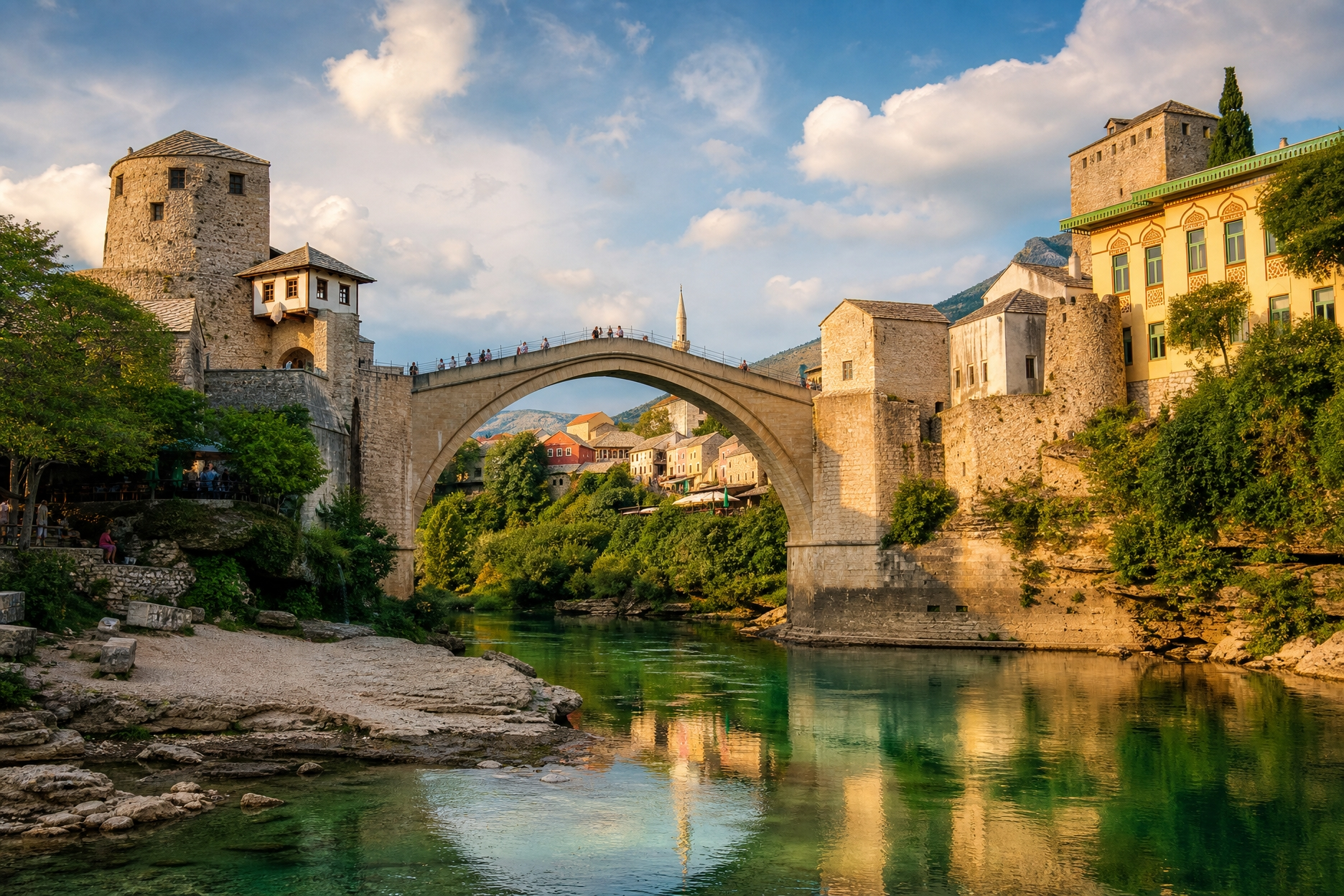
Stay near the Stari Most (Old Bridge) for the best experience — waking up to the sound of the Neretva River is worth the slightly higher price. Riverside apartments run €30 to €50 per night. Guesthouses on the east (Ottoman) bank are the most charming. Hostels in Mostar are well-run and sociable, with dorms at €8 to €14.
Jajce
A small medieval town with a waterfall in its centre. Accommodation is almost entirely apartments and family-run guesthouses at €20 to €35 per night. Limited options — book ahead in summer.
Trebinje
Bosnia's sunniest town, just 30 km from Dubrovnik. Increasingly popular as a base for wine touring in Herzegovina. Guesthouses and apartments run €25 to €50 per night. A good alternative to staying in expensive Dubrovnik while day-tripping across the border.
Beyond the Main Stops
In small towns like Konjic, Bihać, Visoko, and Travnik, expect to find family-run pensions for €15 to €30 per night. These places rarely appear on Booking.com — ask at the local tourist office or look for signs reading "sobe" (rooms).
ℹ️ Good to Know
Money tip: Bosnia is still largely a cash economy. Many guesthouses, smaller restaurants, and transport operators accept cash only. Withdraw BAM from ATMs on arrival — look for UniCredit ATMs to avoid withdrawal fees. A travel-friendly card like Wise or Revolut minimises exchange costs. Do not rely on euros — the exchange rate offered locally is poor.
Things to Do
Sarajevo
Sarajevo is one of Europe's most underrated capitals — a city where Ottoman, Austro-Hungarian, Yugoslav, and modern layers sit within walking distance of each other.
Baščaršija — The 15th-century Ottoman bazaar quarter. Wander the coppersmiths' lane (Kazandžiluk), drink from the Sebilj Fountain (legend says you will return to Sarajevo), and eat ćevapi at Ćevabdžinica Željo, one of the city's oldest restaurants.
Tunnel of Hope (Tunel Spasa) — During the 1992–1995 siege, this 800-metre tunnel under the airport runway was Sarajevo's only link to the outside world. Walk through part of the original tunnel and see the documentary footage. Entry €10. One of the most powerful museum experiences in Europe.
Galerija 11/07/1995 — A photographic memorial to the Srebrenica genocide. Audio guide included. Entry €10. Difficult and essential.
War Childhood Museum — Personal objects donated by Sarajevans who grew up during the siege. Intimate, devastating, and beautifully curated. Entry €5.
Trebević Cable Car — Ride from the city centre to the top of Mount Trebević (€15 return) for panoramic views and the abandoned bobsled track from the 1984 Winter Olympics.
Sarajevo City Hall (Vijećnica) — The rebuilt Moorish Revival building on the Miljacka River. Burned during the siege, painstakingly restored. Entry €5.
Mostar
Stari Most (Old Bridge) — The 16th-century Ottoman bridge that collapsed under shelling in 1993 and was rebuilt stone by stone, reopening in 2004. A UNESCO World Heritage Site and the country's most iconic image. Watch local divers leap 24 metres into the Neretva from the bridge's apex (a centuries-old tradition, now partly a tourist attraction).
Koski Mehmed Pasha Mosque — Climb the minaret for the best view of the Old Bridge. Entry €8.
Old Town Bazaar (Kujundžiluk) — The cobblestone lane leading to the bridge is lined with copperwork, Turkish lamps, and coffee sets. Touristy but atmospheric.
Day Trips from Mostar
Kravica Waterfall — A 25-metre cascade tumbling into an emerald pool. Swimming allowed. Entry €10. Best visited early morning before the tour buses arrive. 40 km south of Mostar — you need a car or organised tour.
Blagaj Tekke — A 16th-century Dervish monastery built into a cliff face at the source of the Buna River. Stunningly photogenic. Entry €5. Just 12 km from Mostar.
Počitelj — A fortified medieval village perched above the Neretva. Climb the tower for views. No entry fee. On the road between Mostar and Kravica — combine both in a half-day.
Jajce
A medieval town where the Pliva River drops 22 metres into the Vrbas River in a waterfall right in the town centre. The Pliva Lakes above the town have photogenic wooden watermills. Combine with the Travnik fortress (45 minutes away) for a full day of central Bosnia.
Tara River Canyon
The deepest river canyon in Europe (1,300 metres). Whitewater rafting on the Tara River is one of Bosnia's top outdoor experiences — 25 km of rapids, waterfalls, and swimming holes. Full-day tours from Foča or Šćepan Polje cost €50 to €70, usually including a traditional meal.
Una National Park
The Una River near Bihać (northwestern Bosnia) runs through cascades, rapids, and waterfalls in a lush green valley. Less visited than Kravica but arguably more beautiful. Excellent for kayaking, rafting, and swimming. You need a car or organised tour — public transport is limited.
Trebinje and Herzegovina Wine Country
Bosnia's southernmost town sits in a sunny, Mediterranean-like microclimate. The surrounding hills produce increasingly respected wines — Vranac (red) and Žilavka (white). Several wineries offer tastings. Combine with a visit to the Hercegovačka Gračanica monastery on Crkvina Hill for panoramic views.
Costs and Budget
Bosnia and Herzegovina is one of the cheapest countries in Europe for travellers. The currency is the Convertible Mark (BAM or KM), pegged to the euro at a fixed rate of €1 = 1.96 KM (roughly €1 = 2 KM for easy mental math). You cannot easily buy or sell BAM outside Bosnia, so withdraw from ATMs on arrival and spend what you have before leaving.
Cash dominates. As of 2026, expect to pay in cash for roughly 60 percent of transactions — buses, taxis, many restaurants, small guesthouses, and all street food. Card acceptance is improving in Sarajevo and Mostar but is unreliable elsewhere.
Daily Budget Ranges
| Travel Style | Daily Cost (per person) | Includes |
|---|---|---|
| Budget | €30–50 | Hostel dorm, bakery lunches, ćevapi dinners, local buses, free walking tours |
| Mid-range | €50–100 | Private guesthouse room, restaurant meals, guided tours, occasional taxi |
| Comfort | €100–170+ | Boutique hotel, fine dining, private transfers, rafting or curated experiences |
Typical Prices (2026)
| Item | Cost |
|---|---|
| Ćevapi (10 pieces with bread) | €3–4 |
| Burek (bakery) | €1–1.50 |
| Local restaurant meal | €4–8 |
| Mid-range restaurant dinner | €10–18 |
| Bosnian coffee (džezva) | €1–1.50 |
| Draught beer (0.5L) | €1.50–2.50 |
| Rakija (shot) | €1–2 |
| Hostel dorm bed | €7–15/night |
| Private guesthouse room (double) | €20–35/night |
| Mid-range hotel (double) | €40–65/night |
| Boutique / upscale hotel | €65–120/night |
| Car rental | €25–45/day |
| Petrol (1 litre) | €1.30–1.50 |
| Sarajevo → Mostar bus | €10–13 |
| Sarajevo → Mostar train | €9–11 |
| Kravica Waterfall entry | €10 |
| Tunnel of Hope entry | €10 |
| Sarajevo tram ticket | €0.90 |
| Taxi (typical city ride) | €2.50–6 |
💡 Pro Tip
Save money: Eat your main meal at lunch — konoba-style restaurants serve the same portions for less at midday. Buy burek from bakeries for breakfast (€1–1.50 for a filling meal). Stay in Trebinje instead of Dubrovnik and day-trip across the border. Travel in May or September for the lowest prices with the best weather.
Essential Tips
Money
Bosnia runs on cash. ATMs dispense BAM only. The best ATM strategy: use UniCredit Bank machines (no withdrawal fee) with a Wise or Revolut card (no foreign transaction fee). Cards are increasingly accepted at hotels and upscale restaurants in Sarajevo and Mostar, but do not count on it elsewhere. The BAM is pegged to the euro, so exchange rate fluctuation is not a concern for Eurozone visitors. Do not try to pay in euros — the rate offered by shops is always poor.
Language
Three official languages — Bosnian, Croatian, and Serbian — are mutually intelligible and essentially the same spoken language with minor differences. Written text appears in both Latin and Cyrillic script, depending on the region (Republika Srpska uses more Cyrillic). English is spoken in tourist areas by younger people. German is more common than English among the older generation, owing to the Bosnian diaspora in Austria and Germany. A few useful phrases: Hvala (thank you), Molim (please/you're welcome), Dobar dan (good day), Koliko košta? (how much does it cost?).
Safety
Bosnia is safe for travellers. The US State Department rates it "Exercise Normal Precautions" (Level 1, same as most Western European countries). The war ended in 1995 and the country is stable. Violent crime against tourists is essentially unheard of. Petty theft is uncommon but exercise normal caution in crowded areas.
One genuine safety concern: landmines. Unexploded ordnance from the 1992–1995 war remains in some rural and mountainous areas, particularly along former front lines. Stick to paved roads, marked trails, and populated areas. Do not wander off-trail in the countryside, especially around Sarajevo's outskirts, the areas around Travnik, and in eastern Bosnia near Srebrenica. Mined areas are sometimes (but not always) marked with red skull-and-crossbones signs. If in doubt, ask locally.
Connectivity
A local SIM card from BH Telecom costs approximately €5 for a data-only package. Purchase in phone shops (not widely available at airports). Alternatively, set up an eSIM from Airalo or Saily before arrival — note that eSIM data is data-only, so you cannot make traditional phone calls. Wi-Fi is available in most cafes and hotels. For full details, see our Best eSIM for the Balkans guide.
The Political Structure (Briefly)
Bosnia and Herzegovina has one of the most complex political structures in the world. The country is divided into two main entities: the Federation of Bosnia and Herzegovina (predominantly Bosniak and Croat, including Sarajevo, Mostar, and most tourist destinations) and Republika Srpska (predominantly Serb, including Banja Luka, Trebinje, and Višegrad). There is also the Brčko District, a self-governing area. You will cross between these entities freely — there are no border controls — but you may notice different flags, scripts (Latin vs Cyrillic), and cultural atmospheres. Understanding this context enriches the visit considerably.
Food to Try
Bosnian cuisine is hearty, meat-heavy, Ottoman-influenced, and astonishingly cheap.
Ćevapi — The national dish. Small grilled minced-meat sausages served in warm somun (flatbread) with raw onion and kajmak (a whipped cream-cheese spread). The best version most travellers try is at Ćevabdžinica Željo in Sarajevo's Baščaršija. A full plate costs €3 to €4.
Burek — Spiralled filo pastry filled with minced beef. Variants include sirnica (cheese), zeljanica (spinach), and krompiruša (potato). Eaten for breakfast, lunch, or as a late-night snack, always with a cup of plain yoghurt. €1 to €1.50 from any bakery (pekara).
Klepe — Bosnian dumplings filled with minced meat, drizzled with garlic yoghurt and paprika oil. Rich, tangy, and addictive.
Sarma — Rice and minced meat wrapped in pickled cabbage leaves and slow-cooked. Comfort food at its finest.
Spit-roasted lamb (Jagnjetina) — The town of Jablanica on the Sarajevo-Mostar road is famous for it. Restaurants line the highway with whole lambs turning on spits outside. Stop for lunch — €10 to €12 for a full plate of melt-in-your-mouth lamb.
Bosnian coffee — This is not Turkish coffee, and Bosnians will correct you if you call it that. Served in a copper džezva with a sugar cube and a piece of rahat lokum (Turkish delight). Do not stir it. Sip slowly. The ritual matters as much as the taste. €1 to €1.50 everywhere.
Desserts — Try tufahija (a whole poached apple stuffed with walnuts and cream), hurmašice (syrup-soaked semolina cookies), and baklava. All available for €1.50 to €3 at sweet shops throughout old towns.
Getting Around Within Bosnia
Buses are the backbone of intercity transport. They go everywhere, they are cheap, and they are generally on time. The Sarajevo–Mostar corridor has the most frequent service (every 1–2 hours, €10–13, 2.5 hours). Buy tickets at the bus station — online booking is available for some routes via FlixBus or 12Go. Expect to pay an additional €1–2 for luggage stored in the hold.
The Sarajevo–Mostar train is one of the most scenic rail journeys in Europe. The track follows the Neretva River through a deep limestone canyon. The journey takes about 3 hours 15 minutes and costs €9 to €11. Only 2–3 departures per day — check the schedule at Sarajevo station. This is a scenic experience, not an efficient commute.
Rental cars change what is possible in Bosnia. Many of the best sights — Kravica, Blagaj, Una National Park, mountain villages — are inaccessible or impractical by bus. Compact cars cost €25 to €45 per day. Roads are mountainous and slow — allow significantly more time than GPS estimates. Speed cameras are common and fines are forwarded to rental companies. Fuel is widely available in towns but can be scarce in remote mountain areas.
Taxis are cheap. Bolt works in Sarajevo. In Mostar and smaller towns, use taxis recommended by your accommodation or agree a fare before getting in. A typical city ride costs €2.50 to €6.
No Uber operates in Bosnia and Herzegovina.
Packing Essentials
Bring comfortable walking shoes — Sarajevo and Mostar involve hills, cobblestones, and uneven surfaces. A light rain jacket is useful in spring and autumn. Cash — more than you think you will need. A universal power adapter (Type C/F) if coming from the US, UK, or Australia. A reusable water bottle for cities (tap water is safe in Sarajevo and Mostar). And most importantly, bring an open mind and patience — Bosnia operates on its own clock, and the rewards come to those who slow down.
ℹ️ Good to Know
Visa note: Bosnia and Herzegovina is not in the EU or the Schengen Area. US citizens can stay up to 90 days within any 6-month period. EU citizens enter visa-free for 90 days with a passport or national ID card. UK, Canadian, and Australian citizens get 90 days visa-free. Your passport must be valid for at least 3 months beyond your intended stay.
Bosnia and Herzegovina is not easy travel. The food is heavy, the politics are complicated, the buses smell like cigarettes, and the history will leave you emotionally drained. But the Neretva is the most beautiful river you will ever see, the coffee ritual will slow your heartbeat, Mostar's bridge at sunset will stop you in your tracks, and the people will welcome you with a generosity that feels increasingly rare in modern Europe. This is not a country you visit for comfort — it is a country you visit for substance.
For travel insurance that covers the Balkans (including non-Schengen countries like Bosnia), see Best Travel Insurance for the Balkans. For connectivity across the region, see Best eSIM for the Balkans.
More Bosnia & Herzegovina Guides
Guide
Best Car Rental in Montenegro (Tested)
A tested comparison of car rental companies in Montenegro for 2026 — international chains vs. local agencies, real prices from Tivat and Podgorica airports, insurance explained without jargon, cross-border rules for Croatia and Albania, and the three self-drive routes that justify the rental cost.
Guide
Montenegro Travel Cost Per Day 2026
A line-by-line breakdown of what Montenegro actually costs in 2026 — accommodation, food, transport, beaches, activities, and national parks at every budget level. Real prices from Kotor to Durmitor, with three worked daily budgets.