📋 Quick Facts
| Detail | Info |
|---|---|
| Currency | Euro (€). Croatia adopted the euro on 1 January 2023. Cards accepted almost everywhere. |
| Language | Croatian. English widely spoken in tourist areas; Italian common in Istria. |
| Visa | US/UK/Canada/Australia: 90 days visa-free (Schengen). EU citizens: free movement. ETIAS not yet live. |
| Power Plug | Type C and F (two round pins, 230V). US and UK travellers need an adapter. |
| Tap Water | Safe to drink throughout the country. No need for bottled water. |
| Emergency | 112 |
| SIM / eSIM | T-HT tourist SIM from €10 (unlimited data, 10 days). eSIM via Airalo from €4.50. EU residents roam free. |
| Best Months | June and September — warm sea, thinner crowds, lower prices. |
Overview
Croatia stretches along the eastern Adriatic like a boomerang — a narrow coastal ribbon backed by mountains, with over 1,200 islands scattered offshore. It manages to fit Roman ruins, Venetian palaces, Austro-Hungarian cafes, and some of the clearest seawater in the Mediterranean into a country roughly the size of West Virginia.
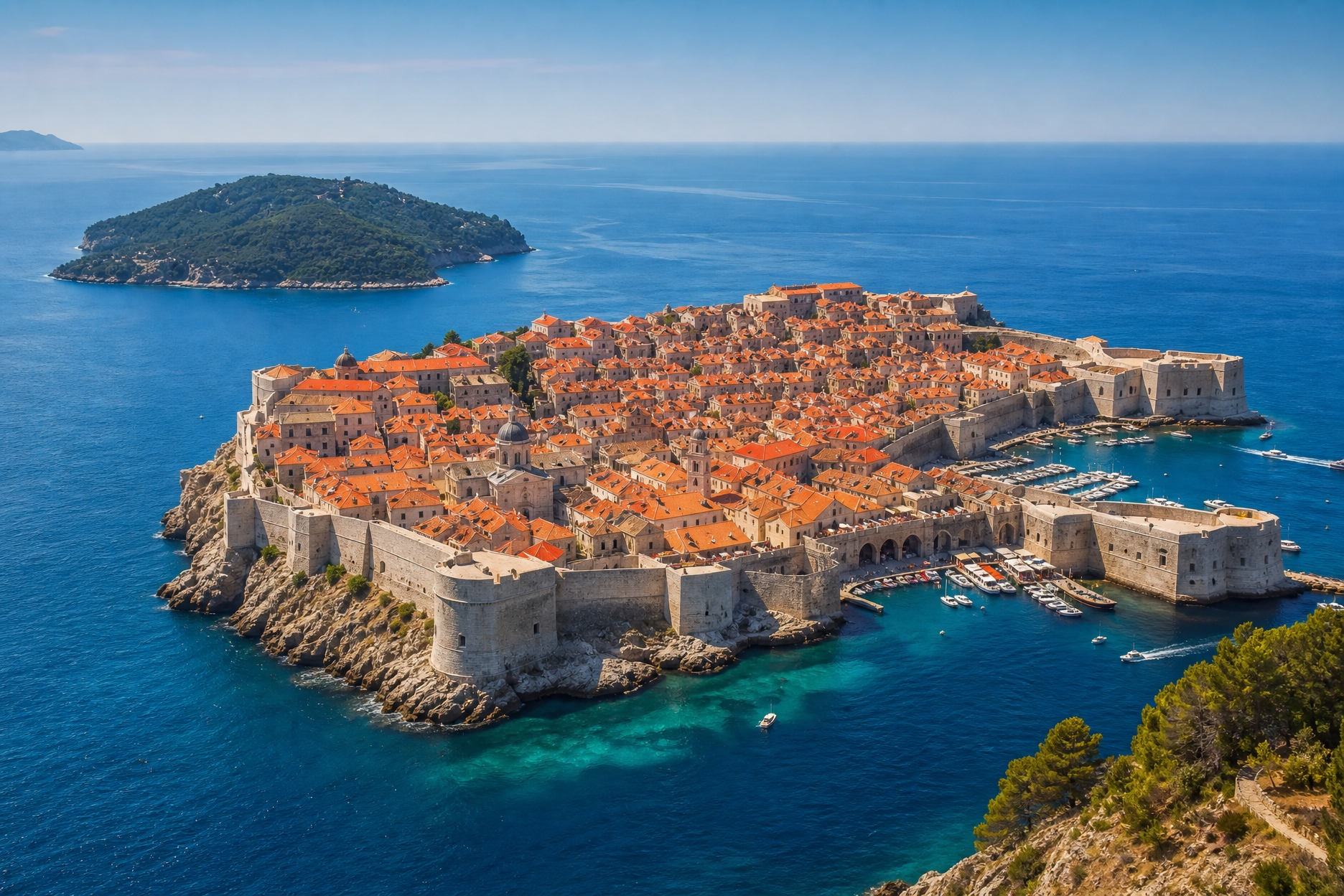
The headline names are earned. Dubrovnik's medieval walls rise straight from the sea. Split's Diocletian's Palace is not a ruin but a living neighbourhood — people sleep, eat, and hang laundry inside a fourth-century Roman emperor's retirement home. Plitvice Lakes drops sixteen terraced lakes down a forested gorge connected by waterfalls. And beyond the headliners, there are hundreds of islands where the only sounds are cicadas and the slap of waves on limestone.
Croatia joined the EU in 2013, adopted the euro in 2023, and entered the Schengen Area the same year. Borders are frictionless, the currency is familiar, and infrastructure is well developed. This is not rough-edged frontier travel — Croatia is polished, well-connected, and set up for visitors.
The trade-off is price. Croatia's restaurants and hotels sit at 95 percent of the EU average — higher than Greece, Slovenia, or any of its Balkan neighbours. A coffee in Split's old town is €2.20, a draught beer €5.50, and a mid-range hotel in Dubrovnik hits €255 per night in July. But timing is the biggest lever you have: the same room in October can cost 40 percent less, and the shoulder months of June and September deliver nearly all the summer experience at a meaningful discount.
Tourism drives a significant share of the economy, and the country now receives over 20 million tourist arrivals per year. Overtourism is a real conversation in Dubrovnik and Hvar in peak season. Visit in shoulder season, venture to the less-famous islands, and you will find stretches of Adriatic coastline that feel genuinely uncrowded.
💡 Pro Tip
Croatia is a Schengen country. Time spent here counts toward your 90-day Schengen limit — relevant if you are also visiting Italy, Greece, or other Schengen states on the same trip. Plan your total Schengen days carefully.
Best Time to Visit
Croatia is a warm-season destination. The coast shuts down significantly from November through March, and island ferry schedules thin out. Plan your trip between May and October.
June and September are the sweet spot. Daytime temperatures along the coast sit at 25–30°C, the Adriatic reaches 22–25°C (warm enough for comfortable swimming), and the peak-season crowds have not yet arrived or have already left. Accommodation prices drop 15 to 30 percent from their July–August peak. September is especially good: the sea retains its summer warmth, the light turns golden, and you can walk Dubrovnik's walls without queuing.
July and August are peak season. The sea is warmest (24–26°C), days are long and hot (30–35°C), beaches and old towns are packed, and prices hit their annual maximum. If you visit in peak season, book accommodation and ferries well in advance, start sightseeing early in the morning, and consider basing yourself on a quieter island like Vis or Korčula rather than Hvar or Dubrovnik.
May and October are shoulder months. Great for sightseeing, hiking, and city exploration. The sea is cool in May (18°C) but pleasant by late May, and still comfortable in October (21°C). National park tickets are significantly cheaper. Many coastal restaurants and hotels are open, but some island businesses may be closed.
November through April is the off-season. Most island and coastal tourism infrastructure closes. Zagreb, Istria, and the national parks remain accessible. Prices are lowest, and the country is quiet. Plitvice under snow is stunning if you time it right.
| Month | Sea °C | Air °C | Crowds | Prices |
|---|---|---|---|---|
| Apr | 15 | 16–20 | Very low | Budget |
| May | 18 | 20–25 | Low | Budget–Mid |
| Jun | 22 | 25–30 | Moderate | Mid |
| Jul | 24 | 28–33 | High | Peak |
| Aug | 26 | 28–35 | Very high | Peak |
| Sep | 24 | 24–29 | Moderate | Mid |
| Oct | 21 | 18–23 | Low | Budget |
How to Get There
Flying In
Croatia has three main international airports: Zagreb (ZAG), Split (SPU), and Dubrovnik (DBV). Split and Dubrovnik handle the bulk of summer tourist arrivals along the coast. Zadar (ZAD) and Pula (PUY) serve smaller but growing numbers of routes.
From the UK, budget carriers Ryanair, easyJet, Jet2, and Wizz Air fly direct to Split, Dubrovnik, Zadar, and Pula with fares from £25 to £80 one way. From mainland Europe, direct flights connect from virtually every capital.
From the United States, direct flights are limited. United flies Newark to Dubrovnik seasonally. The most common routings connect through London, Munich, Vienna, Istanbul, or Rome. Expect €400 to €800 return from the US East Coast.
From Canada and Australia, connect through a European hub. No direct flights exist.
Tip: If your destination is the Dalmatian coast, fly into Split rather than Zagreb. Zagreb to Split is a 4-hour drive or 6-hour bus ride — flying in directly saves a full travel day.
Getting Between Cities
Croatia's intercity transport is efficient and well-priced. Buses are the backbone — comfortable, air-conditioned, and frequent.
| Route | Transport | Cost | Duration | Notes |
|---|---|---|---|---|
| Zagreb → Split | Bus | €20–25 | 5–6 hrs | Frequent, modern coaches. Book via Arriva or FlixBus. |
| Zagreb → Dubrovnik | Bus | €25–35 | 8–10 hrs | Long ride; consider flying (€40–80). |
| Split → Dubrovnik | Bus | €15–22 | 4–5 hrs | Coastal road with border crossing through Bosnia (Neum). Bring passport. |
| Zagreb → Zadar | Bus | €12–18 | 3–3.5 hrs | Easy day-trip base. |
| Zagreb → Plitvice | Bus | €12–15 | 2–2.5 hrs | Book morning departure for a full day at the park. |
| Split → Hvar | Catamaran | €25 | 1 hr | Jadrolinija foot passenger. Car ferry to Stari Grad: €6–8. |
| Split → Brač | Ferry | €5–8 | 50 min | Frequent car ferry to Supetar. |
| Dubrovnik → Korčula | Catamaran | €20–30 | 2 hrs | Seasonal service. |
💡 Pro Tip
The bus from Split to Dubrovnik passes through a 9-km strip of Bosnia at Neum. This is a border crossing — have your passport ready. EU/Schengen citizens can use ID cards. The new Pelješac Bridge now bypasses Neum entirely for those driving, but most buses still take the old route.
Ferries and Island-Hopping
Ferries are both transport and a highlight. The national operator Jadrolinija runs car ferries and catamarans to most major islands. Private operators like Krilo and TP Line add faster catamaran services in summer.
As a foot passenger, ferries are cheap — short crossings start at a few euros. Taking a car is significantly more expensive and books out in summer. For island-hopping, most travellers go on foot and use local buses, scooters, or taxis on the islands.
Book ferries in advance for July and August, especially car ferries. Timetables are seasonal — check Jadrolinija directly.
Driving
Renting a car makes the most sense for Istria, the national parks, and a coastal road trip. Croatia's motorways (autoceste) are modern and tolled. Coastal roads are scenic but narrow and slow in summer.
Expect €20 to €45 per day for a compact car, plus fuel (€1.55–1.70/litre), tolls, parking, and insurance. Parking in old towns is expensive and limited — if you are spending time in Split, Dubrovnik, or on an island, park the car and walk.
Where to Stay
Accommodation is Croatia's biggest single expense, and timing matters more than anything else. The same room can cost €225 in July and €142 in October.
Dubrovnik
The most expensive base in the country. Hotels inside the old town are stratospheric (€300+ per night in summer). Stay in Lapad or Gruž for better value — 15 to 20 minutes from the old town by bus or foot. Budget guesthouses run €60 to €100, mid-range hotels €120 to €200. Apartments (sobe/apartmani) are the local sweet spot: a well-located private apartment typically costs €70 to €130 per night.
Split
Stay inside or near Diocletian's Palace for the best atmosphere. Split is slightly cheaper than Dubrovnik but still pricey in peak season. Private apartments run €60 to €110, mid-range hotels €90 to €180. The Varoš neighbourhood just west of the palace is a good-value base with charm.
Zadar
Often overlooked but one of the best-value coastal cities. A central old-town room runs €40 to €80, with excellent restaurants nearby. Zadar also works well as a base for day trips to the Kornati Islands and Plitvice.
Istria (Rovinj, Pula, Poreč)
Istria has a wider spread: Rovinj is upmarket (€80 to €150 for a mid-range double), while Pula and inland hill towns like Motovun offer better value (€50 to €90). Istria rewards those who rent a car and stay in agriturismo farmstays inland.
Islands
Island accommodation books out fast in summer. Hvar is the most expensive island; Vis and Korčula are more moderate. Expect €70 to €150 for a private room in peak season, less in shoulder months. Book 4 to 6 weeks ahead for July and August.
Zagreb
Croatia's capital is the cheapest major base. Excellent hostels from €15 to €25 per dorm bed, and central hotels from €60 to €120. The Upper Town and Tkalčićeva area are the most atmospheric locations.
ℹ️ Good to Know
Booking tip: Private apartments (apartmani) are almost always better value than hotels of equivalent quality in Croatia. They also give you a kitchen, which significantly cuts food costs. Book through Booking.com or direct with the owner.
Things to Do
Dubrovnik
Walk the City Walls — 2 km of medieval ramparts circling the old town, with views over terracotta rooftops and the Adriatic. The ticket costs about €40 in high season, but the Dubrovnik Pass (also €40) bundles the walls with city buses and several museums, making it the better buy. Visit early morning or late afternoon to avoid the worst crowds and cruise-ship passengers.
Ride the cable car up Srđ Hill for a panoramic view of the entire walled city. Take a kayak tour around the walls at sunset. Ferry to Lokrum Island for swimming, botanical gardens, and peacocks (€15 return, 10 minutes).
Split
Diocletian's Palace is the heart of the city — a living, breathing Roman ruin where 3,000 people still live. Wander the basement halls, climb the bell tower of the Cathedral of St. Domnius, and watch the sunset from the Riva waterfront promenade. Hike Marjan Hill (1 hour loop) for pine-shaded trails and swimming coves. Split is also the main ferry hub for the islands.
Plitvice Lakes National Park
Sixteen terraced lakes connected by waterfalls in a forested gorge. The most visited natural attraction in Croatia. Peak-season tickets cost about €40; late-afternoon entry is cheaper, and spring/autumn tickets drop to €20 or less. Arrive early (before 9am) or visit in May/October to avoid the densest crowds. Allow 4 to 6 hours for the full circuit.
Krka National Park
Often compared to Plitvice but more accessible from the coast (1 hour from Split). Swimming was once allowed at Skradinski Buk falls but is now restricted — check current rules. Ticket pricing mirrors Plitvice's seasonal structure (up to €40 in summer). Combine with a stop in the charming town of Šibenik.
The Islands
Hvar — Lavender fields, yacht-filled harbour, upscale restaurants, and Croatia's best nightlife. Beautiful but expensive and crowded in August. The Lavender Festival in late June is a highlight.
Korčula — A miniature Dubrovnik on a wooded island. Marco Polo's alleged birthplace. Quieter, more affordable, excellent wine (Grk and Pošip).
Vis — The farthest inhabited island from the mainland, and the most unspoiled. Former Yugoslav military base closed to tourists until 1989. The Blue Cave on nearby Biševo is a must-see (boat tour from Komiža).
Brač — Home to Zlatni Rat (Golden Horn), Croatia's most photographed beach — a white-pebble spit that shifts shape with the currents. A quick ferry from Split.
Pag — Lunar landscapes, famous Pag cheese, and the Zrće beach club strip (Croatia's answer to Ibiza). Best for partygoers and cheese lovers.
Istria
Croatia's northwestern peninsula has a distinct Italian-influenced character. Rovinj is a pastel-coloured fishing town with galleries and top-tier restaurants. Pula has a remarkably intact Roman amphitheatre (2,000 years old, still hosts concerts). The inland hill towns — Motovun, Grožnjan, Buzet — are truffle country. Istria's white truffles rival those of Piedmont, and the olive oil is among the best in the world. October brings Truffle Days with festivals across the peninsula.
Zagreb
Often skipped by coast-bound travellers, but Zagreb is a proper Central European capital with substance. Walk the Upper Town (Gornji Grad), visit the Museum of Broken Relationships (one of Europe's most original museums, €7), browse Dolac Market, ride the funicular, and explore the café scene on Tkalčićeva street. Allow at least one full day.
Costs and Budget
Croatia uses the euro (€) and has been in the Schengen Area since 1 January 2023. Cards are accepted almost everywhere — cash is only needed at small markets, some konobas (family restaurants), and for small boat tickets. ATMs are widely available.
Croatia is mid-priced for Europe overall, but the parts you spend money on as a visitor — restaurants, hotels, attraction tickets — are priced close to the EU average. Supermarket food is actually above the EU average (103.7 on Eurostat's index). This is not a budget Balkans destination like Albania or Bosnia — plan accordingly.
Daily Budget Ranges
| Travel Style | Daily Cost (per person) | Includes |
|---|---|---|
| Budget | €55–75 | Hostel dorm, self-catering with one cheap meal, buses, free beaches |
| Mid-range | €110–160 | 3-star hotel or apartment, café plus one restaurant meal, ferries, some tours |
| Comfort | €200+ | 4-5 star hotel, restaurants and wine, private tours, car hire |
Typical Prices (2026)
| Item | Cost |
|---|---|
| Espresso / cappuccino | €2.20–3.00 |
| Draught beer (0.5L, bar) | €4–6 |
| Bottle of house wine (restaurant) | €23–50 |
| Pizza (30cm) | €8–15 |
| Restaurant main course | €10–25 |
| Steak dinner | €25–36 |
| Konoba daily lunch menu (marenda) | €8.50–21 |
| Hostel dorm bed | €20–35/night |
| Private apartment (double) | €50–130/night |
| Mid-range hotel (double, coast) | €90–180/night |
| Peak-season hotel (Dubrovnik, 3-star) | €200–255/night |
| Plitvice Lakes ticket (peak) | ~€40 |
| Dubrovnik City Walls | ~€40 |
| Car rental | €20–45/day |
| Petrol (1 litre) | €1.55–1.70 |
| Split → Hvar catamaran | €25 |
| Zagreb → Split bus | €20–25 |
| T-HT tourist SIM (unlimited, 10 days) | €10 |
💡 Pro Tip
The single biggest money saver: Move your trip from August to June or September. The same hotel room drops 15–30%, park tickets are cheaper, and ferries are less crowded. October drops prices by a third or more, though some island businesses close.
Essential Tips
Money
Croatia uses the euro. Cards (Visa, Mastercard) are accepted at virtually all hotels, restaurants, and shops. A travel debit card with no foreign transaction fees (Wise, Revolut) is the best option. ATMs are everywhere. Tipping is appreciated but not expected — 10 to 15 percent at upscale restaurants, rounding up at casual spots.
Language
Croatian is a South Slavic language, mutually intelligible with Serbian, Bosnian, and Montenegrin. English is widely spoken in tourist areas, especially by younger people. Italian is common in Istria. A few useful phrases: Hvala (thank you), Molim (please/you're welcome), Dobar dan (good day).
Safety
Croatia is very safe. The US State Department rates it "Exercise Normal Precautions" (Level 1). Violent crime against tourists is virtually unheard of. Petty crime (pickpocketing) exists in crowded areas — old towns, bus stations, markets — as it does anywhere in Europe. Keep valuables close in crowded spots.
The only real risk is swimming safety: some beaches have strong currents, and the rocky coastline can cause cuts. Bring water shoes for pebble beaches (which are most of them).
Connectivity
EU residents roam free on their home plans. For non-EU visitors, a T-HT tourist SIM costs €10 for 10 days of unlimited data, or €12 for a month with 70GB. Available at phone stores in any city (not at the airport). Alternatively, set up an eSIM from Airalo or Saily before arrival. Wi-Fi is available in virtually all hotels, cafes, and restaurants. For full details, see our Best eSIM for the Balkans guide.
Food to Try
Croatian cuisine splits between the Mediterranean coast and the Continental interior.
On the coast: Try crni rižot (black squid-ink risotto), peka (meat or octopus slow-roasted under an iron bell — must be pre-ordered), buzara (shellfish in white wine and garlic), grilled fish from the gradela, and pršut (dry-cured ham) with Pag cheese and olives. Do not skip the bread with olive oil — Croatian olive oil, especially Istrian, is world-class.
In the interior: Try štrukli (baked cheese pastry, a Zagreb specialty), ćevapi (grilled minced-meat sausages in flatbread with ajvar), pašticada (slow-braised beef with gnocchi — the queen of Dalmatian cuisine), and sarma (stuffed sauerkraut rolls). For dessert, fritule (fried dough balls dusted with sugar) are addictive.
Drinks: Croatian wines are excellent and underrated. Look for Plavac Mali (a bold red from Pelješac) and Malvazija (a crisp Istrian white). Rakija (fruit brandy) is offered as a welcome drink everywhere — travarica (herbed) and orahovaca (walnut) are the most popular varieties.
Eating tip: Eat at konobas (family-run taverns) rather than tourist restaurants with English menus and white tablecloths. The marenda (daily lunch menu) at a konoba is always the best-value hot meal. Eating your main meal at lunch saves significantly — restaurants charge the same portions for less at midday.
Getting Around Within Croatia
Buses are the best way to move between cities. Modern, air-conditioned, frequent, and reasonably priced. Book through Arriva, FlixBus, or at the station. Trains exist but are slow and limited — skip them for coastal travel.
Ferries connect the mainland to the islands. Use Jadrolinija for car ferries and subsidised catamarans (cheaper), or Krilo/TP Line for fast commercial boats. Travel as a foot passenger to save money — renting a scooter or using local buses on the islands is cheaper than bringing a car across.
Rental cars make sense for Istria, road-tripping the coast, and reaching national parks. Do not bother with a car in Dubrovnik or Split — parking is expensive and old towns are pedestrianised. Cross-border car rental (e.g. picking up in Croatia, dropping off in Montenegro) is possible but must be returned to the same country with most companies.
No Uber in most of Croatia. Bolt works in Zagreb and some larger cities. Taxis are metered and reasonable.
Packing Essentials
Bring water shoes — most Croatian beaches are pebble, not sand. A dry bag is worth its weight for kayaking, boat trips, and beach days with valuables. Sunscreen and a hat are non-negotiable in summer — the Adriatic sun is intense. A light jacket for September evenings and air-conditioned buses. An EU power adapter (Type C/F) if coming from the US, UK, or Australia.
ℹ️ Good to Know
Schengen note: Croatia is part of the Schengen Area. US, UK, Canadian, and Australian citizens get 90 days visa-free within any 180-day period across all Schengen countries combined. If you are also visiting Italy, France, Spain, or Greece on the same trip, your days stack together. Plan accordingly. The ETIAS pre-travel authorisation system has been repeatedly delayed and is not yet live as of September 2026. Monitor the official ETIAS website for updates before booking.
Croatia is not the cheapest country on the Adriatic, but it might be the most complete. You can swim in water so clear it looks artificial, stand inside a Roman palace that people still call home, eat octopus pulled from the sea that morning, and sip wine made from a grape that grows on exactly one island. Time your visit right, eat where the locals eat, and venture past the headline destinations — the Croatia beyond Dubrovnik and Hvar is where the real rewards are.
For island-hopping logistics, compare ferry routes in our Croatia Island-Hopping Guide. For connectivity across the region, see Best eSIM for the Balkans. For travel insurance that covers the Schengen zone, see Best Travel Insurance for the Balkans.
More Croatia Guides
Guide
How Much Does Albania Really Cost?
Real 2026 prices for Albania: accommodation, food, transport, beaches and activities, plus sample budgets for one week on the Riviera and inland.
Guide
Albanian Riviera on a Budget: Daily Costs 2026
A line-by-line breakdown of what the Albanian Riviera actually costs in 2026 — accommodation, food, beaches, transport, and activities at every budget level. Real prices from Himara to Ksamil, with tested strategies to keep your daily spend under €50.
Guide
Albanian Riviera: The Complete 2026 Guide
Everything you need to plan your Albanian Riviera trip in 2026. Beaches, towns, costs, transport, safety, and where to stay — honest, updated, and based on real travel data.
Guide
Best Car Rental in Montenegro (Tested)
A tested comparison of car rental companies in Montenegro for 2026 — international chains vs. local agencies, real prices from Tivat and Podgorica airports, insurance explained without jargon, cross-border rules for Croatia and Albania, and the three self-drive routes that justify the rental cost.