📋 Quick Facts
| Detail | Info |
|---|---|
| Currency | Serbian dinar (RSD). €1 ≈ 117 RSD. Cash-heavy economy — carry dinars. Euros rarely accepted. |
| Language | Serbian (Cyrillic and Latin script). English spoken by younger locals in cities. |
| Visa | US/EU/UK/Canada/Australia: 90 days visa-free within any 6-month period. |
| Power Plug | Type C and F (two round pins, 230V). US and UK travellers need an adapter. |
| Tap Water | Safe to drink in Belgrade and major cities (chlorine taste common). Stick to bottled in rural areas. |
| Emergency | 112 (or 192 police, 193 fire, 194 ambulance) |
| SIM / eSIM | MTS or Yettel prepaid SIM from ~€5. eSIM via Airalo from €4.50. Cash often needed to buy SIM. |
| Best Months | May–June and September — warm, dry, fewer crowds. July for EXIT Festival. |
Overview
Serbia is the Balkans' big, confident heartland — landlocked, loud, unapologetically carnivorous, and genuinely surprised that you came to visit. It is the country in the region that most people skip, and the one that most rewards those who do not.
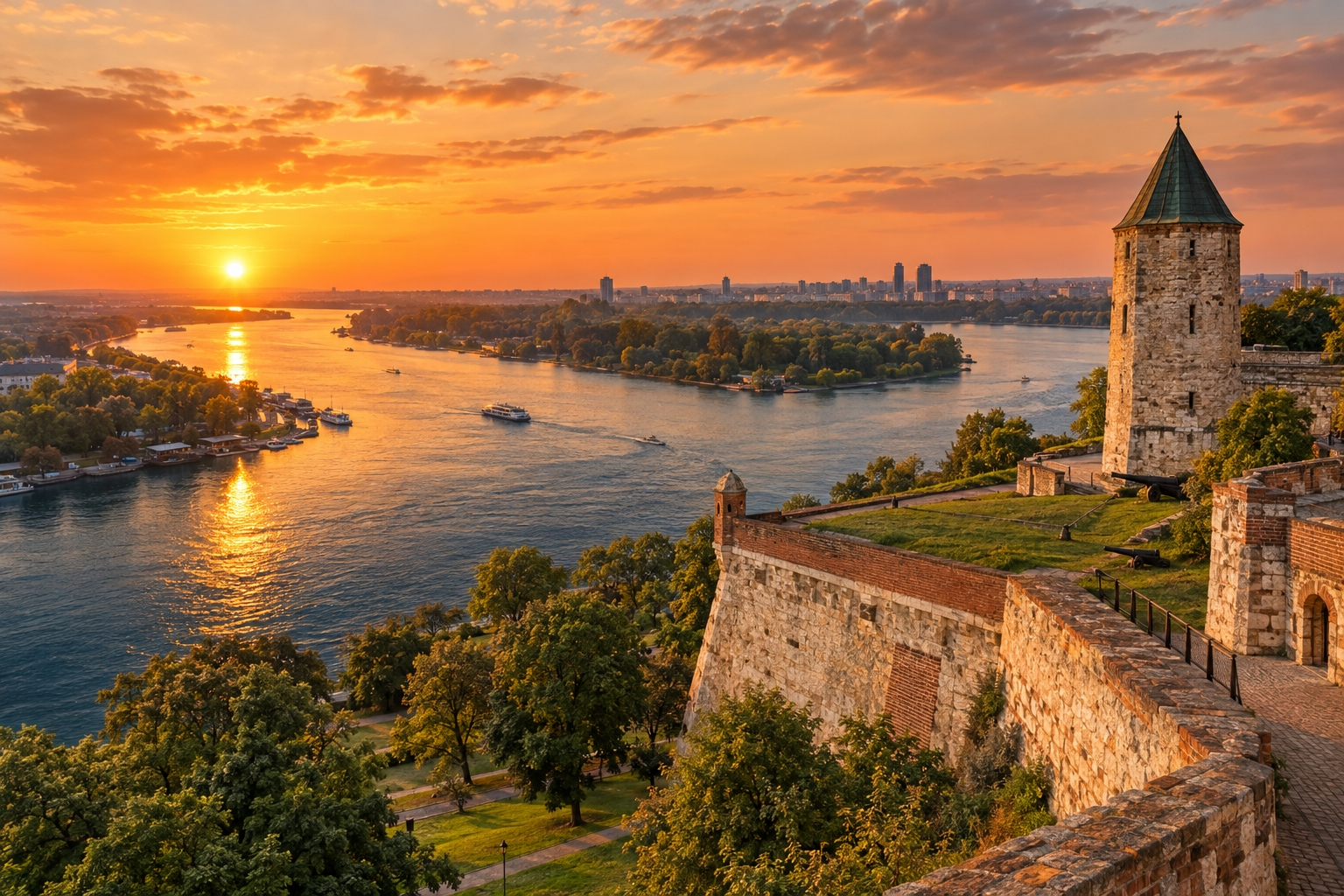
Belgrade sits at the confluence of the Sava and Danube rivers, its fortress watching over a meeting of waters and of civilisations — Roman, Ottoman, Austro-Hungarian, Yugoslav, and modern Serbian layers are all visible from a single viewpoint. The capital has one of the best nightlife scenes in Europe, with floating river clubs (splavovi) that open at midnight and close at dawn, historic kafanas (taverns) where live brass bands play until your table shakes, and a creative energy fuelled by decades of turbulence and defiance.
Beyond Belgrade, Serbia opens up into rolling agricultural plains in the north (Vojvodina), dramatic river gorges in the west (Tara National Park, the Drina canyon), Roman ruins and Ottoman fortresses in the south (Niš), and a wine-and-monastery belt along the Fruška Gora hills. Novi Sad, Serbia's second city, hosts EXIT — one of Europe's biggest music festivals — inside a Baroque-era fortress above the Danube.
Serbia is not in the EU and not in the Schengen Area. It uses its own currency, sets its own visa rules, and moves at its own speed. The country is fiercely independent, politically complex, and culturally rich — you will eat more meat than you thought possible, drink more rakija than you planned, and leave with strong opinions and a desire to return.
The prices are remarkable. A massive plate of ćevapi with bread costs €3. A craft beer in Belgrade's best bar is €2.50. A mid-range hotel double is €40 to €60. A high-speed train from Belgrade to Novi Sad is €6. For travellers looking for substance, culture, and nightlife without the Western European price tag, Serbia is hard to beat.
💡 Pro Tip
Serbia is not in the EU and not in the Schengen Area. Time spent here does not count toward your 90-day Schengen limit. Combined with Bosnia, Montenegro, Albania, and North Macedonia — all non-Schengen — you can build a long Balkans trip without burning Schengen days.
Best Time to Visit
Serbia has a Continental climate with four distinct seasons — genuine winters and hot summers.
May–June and September are the sweet spot. Daytime temperatures range from 22 to 28°C, rain is infrequent, and the cities are lively without peak-season crowds. Outdoor cafes are open, hiking trails are accessible, and the light is beautiful. September is especially good for Fruška Gora wine country and the tail end of summer nightlife.
July and August are peak season. Hot (30–38°C in Belgrade), busy, and when accommodation prices are highest. This is festival season — EXIT Festival takes over Petrovaradin Fortress in Novi Sad (typically mid-July), the Guča Trumpet Festival fills a tiny town in central Serbia with hundreds of thousands of visitors (August), and Belgrade's river clubs are in full swing. If you can handle the heat, the energy is unmatched.
April and October are shoulder months. Good for city breaks and cultural tourism. Temperatures are mild (14–22°C). Some outdoor attractions may have limited operations.
November through March is winter. Belgrade is atmospheric in the cold — cosy kafanas, hot rakija, and a quieter, more local feel. Temperatures hover around 0–8°C, with occasional snow. Kopaonik and Zlatibor have ski resorts popular with domestic tourists.
| Month | Air °C | Rain | Crowds | Prices |
|---|---|---|---|---|
| Apr | 14–20 | Moderate | Very low | Budget |
| May | 18–25 | Moderate | Low | Budget |
| Jun | 22–28 | Low | Moderate | Mid |
| Jul | 25–34 | Low | High | Mid–Peak |
| Aug | 25–38 | Low | High | Mid–Peak |
| Sep | 19–26 | Low | Moderate | Mid |
| Oct | 13–20 | Moderate | Low | Budget |
How to Get There
Flying In
Belgrade Nikola Tesla Airport (BEG) is the main international gateway. Direct flights connect from London (Heathrow and Luton), Paris, Frankfurt, Vienna, Istanbul, Zurich, Rome, Amsterdam, and many others. Wizz Air, Ryanair, and Air Serbia serve most European routes. Air Serbia also flies seasonally from New York (JFK) — one of the few direct transatlantic routes to the Balkans.
Niš Constantine the Great Airport (INI) is a secondary hub with Wizz Air and Ryanair connections to several European cities on budget fares.
From the US (beyond the JFK–Belgrade route), connect through Istanbul (Turkish Airlines), Vienna (Austrian Airlines), or Frankfurt (Lufthansa). From Canada and Australia, no direct flights — connect through a European hub.
Getting from Belgrade Airport to the city centre: City bus line 72 is free (since January 2025 Belgrade public transport has been fare-free). The A1 express bus costs about €3 and takes 30–40 minutes. A taxi costs €20–30 using the airport's fixed-fare voucher system — always use the official taxi desk inside the terminal.
Overland from Neighbouring Countries
Serbia sits at the crossroads of the Balkans and connects easily to all neighbours by bus:
| Route | Transport | Cost | Duration | Notes |
|---|---|---|---|---|
| Budapest → Belgrade | Bus/Train | €15–25 | 5–7 hrs | Multiple daily services. |
| Zagreb → Belgrade | Bus | €18–25 | 5–6 hrs | Frequent departures. |
| Sarajevo → Belgrade | Bus | €20–28 | 6–8 hrs | Multiple daily services. |
| Sofia → Belgrade | Bus | €15–22 | 5–6 hrs | Via Niš. |
| Skopje → Belgrade | Bus | €18–25 | 5–6 hrs | Via Niš. |
| Thessaloniki → Belgrade | Bus | €25–35 | 7–8 hrs | Via Skopje or Niš. |
| Podgorica → Belgrade | Bus | €18–25 | 8–10 hrs | Long ride through mountains. |
💡 Pro Tip
The Belgrade–Novi Sad Soko train is one of the best-value rail experiences in Europe: a modern, high-speed service covering 80 km in just 30 minutes for €6. It turns Novi Sad into an effortless day trip from Belgrade.
Where to Stay
Serbia offers excellent accommodation value across the board. Even Belgrade — the priciest city — is significantly cheaper than any Western European capital.
Belgrade
The most atmospheric neighbourhoods to stay in are Stari Grad (Old Town, around Knez Mihailova and the fortress), Dorćol (trendy, cafes, creative scene), and Savamala (waterfront, nightlife). Budget guesthouses run €25 to €45 per night. Mid-range boutique hotels: €45 to €80. Hostels are excellent: €8 to €18 for a dorm, €20 to €35 for a private double. Apartments on Booking.com or directly from owners offer the best value for longer stays: €30 to €55 per night.
Novi Sad
Serbia's second city is cheaper than Belgrade. Stay in or near the city centre or near Petrovaradin Fortress. Budget rooms run €20 to €35. Mid-range hotels: €35 to €65. Prices spike during EXIT Festival (mid-July) — book months ahead or expect to pay double.
Niš
Southern Serbia's main city is the cheapest of the three. Guesthouses and apartments run €15 to €30 per night. Mid-range hotels: €30 to €50. A good base for exploring southern Serbia and day-tripping to Sokobanja spa town.
Mountain Resorts (Zlatibor, Tara, Kopaonik)
Popular with domestic tourists, especially in winter (ski season) and summer weekends. Apartments and small hotels run €25 to €60 per night. Book ahead for school holidays and long weekends.
ℹ️ Good to Know
Booking tip: Belgrade's accommodation books up during major events — EXIT Festival (Novi Sad, July), Belgrade Beer Fest (August), and Guča Trumpet Festival (August). Book 4 to 8 weeks ahead if your trip coincides with any of these.
Things to Do
Belgrade
Belgrade is one of Europe's most underrated capitals — gritty, generous, and wildly energetic after dark.
Kalemegdan Fortress — The ancient fortress at the confluence of the Sava and Danube rivers. Free to enter. Walk the ramparts, visit the Military Museum (€3), and watch the sunset over the rivers. The most important landmark in Belgrade and the best free activity in the city.
Knez Mihailova — Belgrade's main pedestrian boulevard. Lined with elegant 19th-century buildings, shops, cafes, and street musicians. Connects the fortress to Republic Square and the National Museum.
Skadarlija — Belgrade's bohemian quarter. A short cobblestone lane of traditional kafanas (taverns) with live music, grilled meats, and free-flowing rakija. Touristy but genuinely atmospheric in the evening. Expect to spend €10 to €20 for a full dinner with drinks.
Nikola Tesla Museum — Dedicated to Serbia's most famous scientist. Interactive exhibits with live demonstrations of Tesla coils. Entry €8 to €15. Small but fascinating.
Temple of Saint Sava — One of the largest Orthodox churches in the world. The interior mosaics, completed in 2024, are breathtaking — 15,000 square metres of gold and jewel-toned mosaic work. Free entry.
Zemun — A neighbourhood on the Danube with an Austro-Hungarian feel completely distinct from the rest of Belgrade. Walk the riverfront promenade, climb Gardoš Tower for views, eat fish at a riverside restaurant. Reachable by city bus (free).
Belgrade Nightlife — The real reason many travellers come. The splavovi (floating river clubs) along the Sava and Danube are legendary: massive venues on barges that open at midnight and close at dawn, Thursday through Sunday. Expect house, techno, turbo-folk, and pop depending on the venue. Cover is usually free or €5 to €10. Drinks inside are €3 to €6. The scene peaks from May to October. Beyond the splavovi, the Savamala district and Cetinjska street in Dorćol have excellent cocktail bars and underground clubs.
Novi Sad
Petrovaradin Fortress — A massive 18th-century Austro-Hungarian fortress overlooking the Danube. Free to walk. Home to galleries, workshops, cafes, and the famous upside-down clock tower. In July, it transforms into the stage for EXIT Festival.
EXIT Festival — One of Europe's biggest music festivals, held annually since 2000 inside Petrovaradin Fortress. Four days of electronic, rock, hip-hop, and world music across 40+ stages. Tickets from €100 to €200 for a multi-day pass. The setting — a fortress above the Danube — is unmatched.
Novi Sad City Centre — Walk Zmaj Jovina (pedestrian street), visit the colourful Dunavska street, have coffee in the Trg Slobode (Liberty Square), and browse the Matica Srpska Gallery (oldest Serbian cultural institution, €3).
Fruška Gora — A low mountain range just south of Novi Sad, covered in vineyards, orchards, and 17 medieval Serbian Orthodox monasteries. Excellent for a day of wine tasting and monastery hopping by car. Wine tastings typically €15 to €30 with food pairings.
Niš
Niš Fortress — A well-preserved Ottoman fortress on the banks of the Nišava River. Free to walk. Contains a concert venue, cafes, and the ruins of a Roman road.
Skull Tower (Ćele Kula) — A tower built from the skulls of Serbian rebels after an 1809 uprising. One of the most unusual and sobering historical monuments in Europe. Entry €3.
Mediana — A Roman archaeological site on the outskirts of Niš. The Roman Emperor Constantine was born here. Well-preserved mosaics and the foundations of a large imperial villa. Entry €3.
Western Serbia
Tara National Park — Dense forest, dramatic viewpoints over the Drina River canyon, and the famous House on the Drina (a tiny wooden house perched on a rock in the middle of the river — one of Serbia's most photographed images). Excellent hiking. The Šargan Eight railway (a narrow-gauge heritage line looping through the mountains) is nearby.
Uvac Special Nature Reserve — A serpentine river canyon that creates dramatic horseshoe meanders visible from clifftop viewpoints. Home to a large colony of griffon vultures. Boat tours through the canyon cost €15 to €25. One of the most spectacular (and least-visited) natural sites in the Balkans.
Mokra Gora (Drvengrad) — A traditional wooden village reconstructed by filmmaker Emir Kusturica. Quirky, photogenic, and close to the Šargan Eight railway. Entry €5.
Zlatibor and Kopaonik
Serbia's two main mountain resorts. Zlatibor is a grassy highland plateau at 1,000 metres — popular for hiking, cycling, and clean air. The Zlatibor Gold Gondola is one of the longest gondolas in the world (9 km). Kopaonik is Serbia's premier ski resort in winter and a hiking destination in summer.
Costs and Budget
Serbia is one of the cheapest countries in Europe for travellers. The currency is the Serbian dinar (RSD), and €1 is approximately 117 RSD. You cannot easily buy or sell dinars outside Serbia, so withdraw from ATMs on arrival and spend what you have before leaving.
Cash still dominates, especially outside Belgrade. Card acceptance is growing in Belgrade's restaurants, hotels, and shops, but is unreliable in smaller cities, bakeries, taxis (unless using an app), and rural areas. Carry dinars everywhere.
Daily Budget Ranges
| Travel Style | Daily Cost (per person) | Includes |
|---|---|---|
| Budget | €30–55 | Hostel dorm, bakery breakfasts, ćevapi dinners, free city transport, free fortress walks |
| Mid-range | €60–110 | Private hotel room, restaurant meals, occasional taxi, museum entries, a night out |
| Comfort | €120–200+ | Boutique hotel, fine dining, wine tours, private transfers, splavovi VIP |
Typical Prices (2026)
| Item | Cost |
|---|---|
| Ćevapi (10 pieces, with bread and kajmak) | €3–4 |
| Pljeskavica (Serbian burger) | €2.50–4 |
| Burek (bakery) | €1–2 |
| Local restaurant meal | €4–8 |
| Mid-range restaurant dinner (with wine) | €12–22 |
| Espresso / coffee | €1–1.50 |
| Draught beer (0.5L, bar) | €1.50–3 |
| Craft beer (bar) | €2.50–4 |
| Rakija (shot) | €1–2 |
| Cocktail (Belgrade bar) | €4–7 |
| Hostel dorm bed | €8–18/night |
| Private guesthouse room (double) | €20–40/night |
| Mid-range hotel (double) | €40–70/night |
| Boutique hotel (Belgrade) | €70–120/night |
| Belgrade city transport | Free (since Jan 2025) |
| Belgrade → Novi Sad (Soko train) | €6–7 |
| Belgrade → Niš (bus) | €10–15 |
| Car rental (per day) | €30–50 |
| Petrol (1 litre) | €1.40–1.60 |
| Taxi (typical Belgrade ride) | €3–6 |
| Nikola Tesla Museum | €8–15 |
| EXIT Festival (multi-day pass) | €100–200 |
💡 Pro Tip
Save money: Belgrade city transport is free — use it. Eat at grill restaurants (ćevapi, pljeskavica) and bakeries (burek) instead of sit-down restaurants. Drink at kafanas rather than cocktail bars. Stay in Dorćol or Vračar instead of Stari Grad for lower accommodation prices with more local character.
Essential Tips
Money
Serbia uses the Serbian dinar (RSD). ATMs are widely available in all cities and dispense dinars only. A travel debit card with no foreign transaction fees (Wise, Revolut) is the best option. Cards are increasingly accepted in Belgrade but unreliable elsewhere — always carry cash. Euros are not accepted in most places (unlike in some other Balkan countries). Do not try to pay in euros — you will get a poor rate or be refused.
Tipping is not mandatory but appreciated. At restaurants, 10 percent is generous; rounding up is standard at casual spots.
Language
Serbian is written in both Cyrillic and Latin script — both are official. Street signs, menus, and public transport displays switch between the two, sometimes within the same block. In practice, Latin script dominates in Belgrade and tourist areas. Cyrillic is more common in rural areas and in Republika Srpska (the Serb entity of Bosnia).
English is spoken by younger people in Belgrade and Novi Sad. Outside the main cities, it drops off quickly. German and Russian are sometimes more useful than English with older generations. A few essential phrases: Hvala (thank you), Molim (please/you're welcome), Dobar dan (good day), Koliko košta? (how much?), Živeli! (cheers! — you will need this one).
Safety
Serbia is safe for travellers. The US State Department rates it "Exercise Normal Precautions." Violent crime against tourists is extremely rare. Petty crime (pickpocketing, bag-snatching) is uncommon but exercise normal caution in crowded areas, bus stations, and on public transport.
Nightlife safety: Belgrade's splavovi and clubs are generally safe, but drink spiking can occur as in any nightlife scene. Watch your drink. Use the official taxi voucher system at the airport, and agree on fares before getting into unlicensed taxis.
Kosovo note: Serbia does not recognise Kosovo's independence. If you plan to visit both, be aware that entering Kosovo from Serbia and then trying to re-enter Serbia can create complications (Serbia may consider you to have left without a proper exit stamp). If visiting both countries, enter Kosovo from a third country (Albania, North Macedonia, or Montenegro) and exit the same way, or consult current entry requirements before your trip.
Connectivity
A local SIM card from MTS (largest network, best coverage) or Yettel costs approximately €5 for a data package. Available at phone shops in any city. Alternatively, set up an eSIM from Airalo or Saily before arrival. Belgrade has excellent 4G/5G coverage. Rural coverage can be patchy.
Free public Wi-Fi is available in Belgrade city centre, most cafes, and all hotels. For full details on eSIM options, see our Best eSIM for the Balkans guide.
Belgrade public transport is free — since 1 January 2025, all regular city bus, tram, and trolleybus lines operate without tickets. The A1 airport express is the exception (€3).
Food to Try
Serbian cuisine is a meat lover's paradise — heavy, generous, grilled, and deeply satisfying.
Ćevapi — The national street food. Small grilled minced-meat sausages (beef and pork or beef and lamb) served 5 or 10 at a time in warm lepinja (flatbread) with chopped onion and kajmak (a rich, tangy cream cheese). Belgrade's Stari Grad and Skadarlija have the most famous ćevapi spots. €3 to €4 for a full plate.
Pljeskavica — The Serbian burger. A large, hand-formed grilled patty served in lepinja with kajmak, ajvar (roasted pepper relish), and onions. Often massive. €2.50 to €4.
Burek — Filo pastry filled with meat (burek), cheese (sirnica), spinach (zeljanica), or potato (krompiruša). Eaten for breakfast or as a late-night snack, always with a cup of plain yoghurt. €1 to €2 from any bakery.
Karađorđeva šnicla — A rolled veal or pork steak stuffed with kajmak, breaded and fried. Named after the Serbian revolutionary leader. Decadent and enormous. Found on most restaurant menus.
Ajvar — A roasted red pepper and aubergine relish. Every family has their own recipe. Homemade ajvar is the gold standard — buy jars at markets in September and October (ajvar-making season).
Sarma — Minced meat and rice wrapped in pickled cabbage leaves and slow-cooked for hours. A winter staple, comfort food at its finest.
Rakija — Fruit brandy and the national drink. Šljivovica (plum) is the most traditional; kajsijevača (apricot), dunjevača (quince), and viljamovka (pear) are also common. Homemade rakija is a point of pride — if a Serbian offers you their family's bottle, accepting is both polite and wise. Sip, do not shoot.
Serbian coffee (domaća kafa) — Similar to Turkish/Bosnian coffee. Served in a small pot (džezva) with a glass of water. Stronger than espresso. €1 to €1.50 everywhere.
Wine: Serbian wines are excellent and virtually unknown outside the country. Prokupac (a native red) is having a renaissance. Tamjanika (an aromatic white) is unique to Serbia. The Fruška Gora hills, the Negotin region (east), and the Šumadija area (central) are the main wine regions.
Getting Around Within Serbia
Belgrade city transport is free (since January 2025). Buses, trams, and trolleybuses run throughout the city without tickets. This is exceptional value and makes getting around Belgrade effortless.
The Soko train between Belgrade and Novi Sad is modern, fast (30 minutes), and cheap (€6 to €7). Beyond this corridor, trains are slow and limited — buses are almost always the better option between other cities.
Buses are Serbia's intercity backbone. Comfortable, frequent, and cheap. Belgrade to Niš costs €10 to €15 (3 to 4 hours). Book at the bus station or through FlixBus. Expect to pay €1 to €2 extra for luggage in the hold.
Rental cars unlock western and southern Serbia — Tara National Park, Uvac canyon, the monasteries, and the mountain resorts are all difficult or impossible to reach by public transport. Compact cars cost €30 to €50 per day. Motorways are tolled (€3 to €10 depending on distance). Roads are generally good on major routes; rural roads can be narrow and potholed. Speed cameras are common.
Taxis are cheap and metered. A typical Belgrade ride costs €3 to €6. Use the CarGo or Pink Taxi app, or hail official taxis with a "TX" prefix on the plates. Agree on fares if there is no meter.
No Uber in Serbia. Local ride-hailing apps (CarGo) work in Belgrade.
Packing Essentials
Bring comfortable walking shoes — Belgrade is hilly with uneven pavements and cobblestones. A light jacket for summer evenings (Belgrade sits at the confluence of two rivers and catches breezes). Cash — more than you think. A universal power adapter (Type C/F) if coming from the US, UK, or Australia. Sunscreen in summer — the Continental sun is strong. And an appetite — Serbian portions are enormous.
ℹ️ Good to Know
Visa note: Serbia is not in the EU or the Schengen Area. US, EU, UK, Canadian, and Australian citizens can stay up to 90 days within any 180-day period visa-free. Your passport must be valid for at least 90 days beyond your intended stay. If you plan to visit both Serbia and Kosovo on the same trip, research the current border regulations carefully before travelling.
Serbia is not a country that tries to charm you with postcard views and Instagram angles. It grabs you by the arm, pulls you into a kafana, orders you a plate of ćevapi the size of your head, fills your glass with homemade šljivovica, and refuses to let you leave until the brass band has played its last song at 3am. The fortress is free, the beer is cheap, the people are fiercely warm, and the nightlife is legendary. Come hungry, stay late, and leave with stories.
For connectivity across the region, see Best eSIM for the Balkans. For travel insurance covering non-Schengen Balkan countries, see Best Travel Insurance for the Balkans.